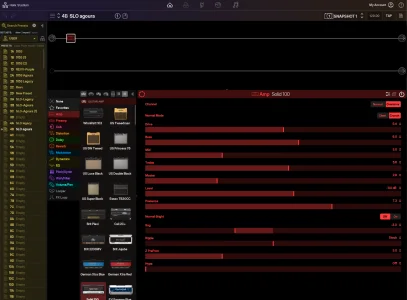
Line 6 Helix Stadium Talk

B is agoura. I did some comparisons and the Agoura model seems more scooped than the handful of other sims I tried.
I also just grabbed one of Ed's old demo's and I duplicated his HX settings and it came out identical to his one. I then used the Agoura model and same as my example here.

Ironically I do like the Agoura but it seems like the anomaly compared to others. Normally with a SLO I'll scoop the mids and crank the top end but I guess if the Agoura model leans scooped by nature then I was just double fry-ing it which is why it kept sounding odd to me before bothering to run it against other models. Now that I know not to cook the top end and give it some mids, I'm getting some great results with it.
It sounds a lot better to me.

I'm not hearing anything there that couldn't be down to different "internal" master levels, poweramp saturation, preamp tubes, bias, etc etc.

It certainly doesn't sound "wrong" at all.

And it also kinda flies in the face of what some of us have been saying about Agoura being darker than HX - coz it clearly isn't in this example. Actually, HX sounds kinda shitty to me in comparison.

I would say, don't assume that 5.0 on HX is the same as 5.0 on Agoura. Because we just don't know that. Internal model voltages and currents and what not could be massively different even at the same parameter settings.
 
Take a listen and let me know what you think. After putting it under a microscope I know why it initially threw me off. At least all of this has paid dividends cause I know how to work with it now.


Legacy
View attachment 59118

Agoura
View attachment 59119

Same cab for both. Also a tubescreamer with the same settings for both.
View attachment 59120

Yep B sounds better, but I think they're different enough where whichever one you dial in to sound good, matching the settings to the other one won't translate well. I still can't really understand why the difference is so big.
 
I would say, don't assume that 5.0 on HX is the same as 5.0 on Agoura. Because we just don't know that. Internal model voltages and currents and what not could be massively different even at the same parameter settings.
The thing is, we DO know that Line 6 model pot tolerances, bias, voltages etc on the old model. My wall voltage swings as much as the next person, and while it does cause a difference, it doesn't transform it into another amp. Only a mistake (either in the old model or new one) can cause a difference that big. If the old model was simply THAT inaccurate, I stand corrected.
 
The thing is, we DO know that Line 6 model pot tolerances, bias, voltages etc on the old model. My wall voltage swings as much as the next person, and while it does cause a difference, it doesn't transform it into another amp. Only a mistake (either in the old model or new one) can cause a difference that big. If the old model was simply THAT inaccurate, I stand corrected.
I sorta disagree actually.

2017. Man models SLO. Amp is biased to 70mV.
2024. Man models SLO. Amp is biased to 60mV.

All other variables being equal, they'll still sound different. A colder bias would result in the amp being brighter and harsher sounding. And neither of those values is "correct" really; it's a taste thing.

But the simple reality is, we just don't know. Fairly confident it would be the exact same SLO amp they modelled though. Not like Neural who did an old one for their VST and a new one for their hardware, iirc.

I've not played the SLO much myself actually. I'll have a bash now.
 
All other variables being equal, they'll still sound different. A colder bias would result in the amp being brighter and harsher sounding. And neither of those values is "correct" really; it's a taste thing.
There is a bias control though in both eras of modelling. And the values of that control are based on voltages within the amp. Even if Line 6 changes the way they calculate the bias, you could adjust that control by ear and match. And regardless of that, bias aint ever going to make this much tonal difference. A hotter or colder bias is quite a different sonic effect than what this is showing. Its not bias.


Fairly confident it would be the exact same SLO amp they modelled though. Not like Neural who did an old one for their VST and a new one for their hardware, iirc.
Yep, I'm assuming it's the same one too. Purely because they both seem to be pre-BAD models built by Mike Soldano. Maybe Line 6 have several and one just sounds very different.
 
There is a bias control though in both eras of modelling. And the values of that control are based on voltages within the amp. Even if Line 6 changes the way they calculate the bias, you could adjust that control by ear and match. And regardless of that, bias aint ever going to make this much tonal difference. A hotter or colder bias is quite a different sonic effect than what this is showing. Its not bias.


Yep, I'm assuming it's the same one too. Purely because they both seem to be pre-BAD models built by Mike Soldano. Maybe Line 6 have several and one just sounds very different.
All quibbles aside, I think we all need to stop expecting HX and Agoura to sound the same, or to match. That's pretty much the antithesis of having a new modelling engine full stop.


I wish the discussion could revolve more around behaviour than actually trying to mimic the frequency response of a reference. Which is always pretty difficult to do anyway regardless of gear. But what I want to know is, why do so many of the high gain amps have a tendency to be too dark; the SLO being an exception.

It could be a behavioural thing, or it could be a defaults thing. I can get a satisfying amount of fizz and cut, but I really have to drop the masters quite low and then make up for the lack of volume on the channel level or cab block, and it feels a little unintuitive to me.
 
All quibbles aside, I think we all need to stop expecting HX and Agoura to sound the same, or to be match. That's pretty much the antithesis of having a new modelling engine full stop.
I really don't want to drone on, but I couldn't disagree more here. This discussion is turning into "which do I like the sound of better?" which is moving well away from the discussion of accuracy. They shouldn't match but they also shouldn't be that far apart.

If Cliff releases a brand new engine that promises better accuracy, I'd be pretty concerned if the differences were this big. The improvements are incremental, unless he finds a bug. The same is true of ToneX and NDSP's recent updates to their capture tech - they sound noticeably better but when you compare old and new to the reference its iterating down to a common goal, not something thats apples and oranges. You can hear the old one was close, and the new version is closer still.

I think the SLO tones posted in the thread sound good, and thats all well and good. The fact that they are so different is definitely a "huh" thing to me though, and it can't be explained by "yeah its just more accurate now" or "oh its just the wall voltage/bias was different that day".

I'll post some clips


Settings here. Take into account the knobs go from 0-9 and not 10. Also take into account tolerances, the fact it's a modded JCA, loads, bias, valves, voltages etc. Helix settings were pretty damn close all things considered.

SLO.jpeg

image.png-2.webp


AGOURA.jpg


I like the Agoura tone but it deviates from the real amp in a way that the previous model didn't. This just doesn't add up to me, and no one really has an answer as to why.

 

Attachments

  • image.png.webp
    image.png.webp
    175.7 KB · Views: 4
Last edited:
I’ve yet to run into a case where I’ve not preferred Agoura over Hx by a wide margin. I fought Hx amp modeling the entire time I owned Helix so I’m actually pleased that there’s a difference.

The last couple days I’ve made an effort to spend more time with Agoura and I’m noticing my desire to constantly tweak and chase ghosts is non-existent. I’ve just been sitting down and playing. Not tweaking, not chasing, just playing. Just like I do with my amps.

I’ve even come around the higher gain IIC+ tones where I’ve got some absolutely filthy brutal stuff happening.

@Orvillain FWIW I am finding that some of that darkness I was experiencing in the IIC+ can be mitigated with the GEQ. After some research, I did find evidence that the IIC+ reissue (what L6 used as their reference) does have a different GEQ taper than the original. I don’t know if that’s the totality of the issue with that model, but it’s def part of it.
 
I really don't want to drone on, but I couldn't disagree more here. This discussion is turning into "which do I like the sound of better?" which is moving well away from the discussion of accuracy. They shouldn't match but they also shouldn't be that far apart.

If Cliff releases a brand new engine that promises better accuracy, I'd be pretty concerned if the differences were this big. The improvements are incremental, unless he finds a bug. The same is true of ToneX and NDSP's recent updates to their capture tech - they sound noticeably better but when you compare old and new to the reference its iterating down to a common goal, not something thats apples and oranges. You can hear the old one was close, and the new version is closer still.

I think the SLO tones posted in the thread sound good, and thats all well and good. The fact that they are so different is definitely a "huh" thing to me though, and it can't be explained by "yeah its just more accurate now" or "oh its just the wall voltage/bias was different that day".

I'll post some clips


Settings here. Take into account the knobs go from 0-9 and not 10. Also take into account tolerances, the fact it's a modded JCA, loads, bias, valves, voltages etc. Helix settings were pretty damn close all things considered.

View attachment 59121
View attachment 59122

View attachment 59123

I like the Agoura tone but it deviates from the real amp in a way that the previous model didn't. This just doesn't add up to me, and no one really has an answer as to why.


In your clip there, the HX amp has markedly softer transients than the real amp does. So I'm not quite sure what the point is here? That clip does not demonstrate that HX is more accurate to the real amp than Agoura is. Although I will concede that BOTH of them don't sound the same as your real amp clip.


So here's my argument... It's like this .... let's say at a particular point in time, the modelling engine used Hammerstein-Wiener techniques:

And it's like... quite accurate, but not 100%.... but close enough to make a product from. Better than anything you did in the past. Okay. Cool.

10 years later, DSP processing is cheaper, so you can do more with the same budget. The modelling engine moves over to Wave Digital Filters:

Now the former is based on idealisation... while the second is based on emulating physical properties.

If you're using the former as your baseline, that could very well make you think that the newer is not as accurate.

If you compare the Axe FX II and the later firmware versions to the Axe FX III and the latest firmware versions, the difference is most likely just as huge as comparing Helix OG to Agoura.

Expecting Agoura to sound the same as Helix OG is like expecting a 1991 Fiesta to drive the same as a 2021 Fiesta.

(yay! Car analogies!)


But my argument is nothing to do with preference. My argument is about physical behaviour, and whether Agoura does things correctly or not.
 
I’ve yet to run into a case where I’ve not preferred Agoura over Hx by a wide margin. I fought Hx amp modeling the entire time I owned Helix so I’m actually pleased that there’s a difference.

The last couple days I’ve made an effort to spend more time with Agoura and I’m noticing my desire to constantly tweak and chase ghosts is non-existent. I’ve just been sitting down and playing. Not tweaking, not chasing, just playing. Just like I do with my amps.
Yeah totally. Ive spent the last few days with Panama, Revv's and SLO today. When I occasionally goto an older model for whatever reason im like... this is less good. I almost dont like the way they blur the lines of Agoura and non Agoura all being in "Guitar Amps". I'd prefer Agoura Only / Legacy
 
In your clip there, the HX amp has markedly softer transients than the real amp does. So I'm not quite sure what the point is here? That clip does not demonstrate that HX is more accurate to the real amp than Agoura is. Although I will concede that BOTH of them don't sound the same as your real amp clip.
The point is that Agoura should sound somewhere between Helix Legacy and the real amp. Ideally closer towards the real thing. It might sound better and have amp like attributes that weren’t present in Legacy, but it’s also just…. different. That’s the entire point i’m making.
Expecting Agoura to sound the same as Helix OG is like expecting a 1991 Fiesta to drive the same as a 2021 Fiesta.
No it isn’t. They aren’t modelling a real reference with a goal of accuracy, warts n all. They are building cars with totally different priorities and goals.

The best analogy I can think of is you have a watch but it doesn’t tell you seconds. So you have a reasonable idea of the time but it’s not totally accurate to the ACTUAL time. Eventually you buy a new watch. This one goes down to milliseconds. You’d expect both to tell you the same minute time, or very close, unless one is just totally wrong. The more accurate one just hones in on a deeper level.
 
And it’s not just Helix Legacy being an anomaly, most SLO plugins get much closer to each other than Helix and Agoura at the exact same settings:


This is the kind of accuracy I’m looking for. I totally concede that others might not care, but for anyone who does, it’s very intriguing that it’s as different as it is. I know it’s Leo Gibson etc, but he felt like something was way off (when comparing to his amp and other models) without really doing any deep diving like we have here.

And if the goal is “hey, we adjusted and hyped the sound of the amp because we prefer it” then cool.
 
The point is that Agoura should sound somewhere between Helix Legacy and the real amp. Ideally closer towards the real thing. It might sound better and have amp like attributes that weren’t present in Legacy, but it’s also just…. different. That’s the entire point i’m making.
But how do you know that HX OG wasn't less accurate? Because again, your clip does not demonstrate it is more accurate than Agoura. The transient softness is a dead give away. It sounded completely different to the real amp.

The best analogy I can think of is you have a watch but it doesn’t tell you seconds. So you have a reasonable idea of the time but it’s not totally accurate to the ACTUAL time. Eventually you buy a new watch. This one goes down to milliseconds. You’d expect both to tell you the same minute time, or very close, unless one is just totally wrong. The more accurate one just hones in on a deeper level.
That's not a bad analogy, so let's go with it.

The UI of HX says there are two hands on the clock. But actually, under the hood there are 4. With Agoura, the UI says there are two hands on the clock, but actually there are 16. Thus the resolution is far greater, and it is capable of representing physical behaviour more accurately.

My position is about model resolution vs model correctness, not “which clip sounds nicer.”

I'm seeing it in one thing I'm building now. Oversmoothing data can cause accuracy issues. So I'd be interested to know what the smoothing characteristics in the nonlinear solver were like across HX and Agoura; of course nobody is ever going to tell us that!!
 
@MirrorProfiles
Based on your video:


That Neural model sounds absolutely fucking dickbawls compared to the Jet City. The Neural one has a scratchiness to it, almost a kind of alias-like quality.

Jet City sounds fucking epic actually.

Amplitube sounds crap, as per usual. :rofl
 
But how do you know that HX OG wasn't less accurate? Because again, your clip does not demonstrate it is more accurate than Agoura. The transient softness is a dead give away. It sounded completely different to the real amp.
The OG sounds closer to the real amp than Agoura does. Not saying it’s a benchmark, but the Agoura one has a totally different voicing that is not in the amp. Yes there is room for improvement, but the Agoura one is not refining something close, it’s very different. And yes, it has some nice characteristics but it isn’t closer to the amp.

The UI of HX says there are two hands on the clock. But actually, under the hood there are 4. With Agoura, the UI says there are two hands on the clock, but actually there are 16. Thus the resolution is far greater, and it is capable of representing physical behaviour more accurately.

My position is about model resolution vs model correctness, not “which clip sounds nicer.”

I'm seeing it in one thing I'm building now. Oversmoothing data can cause accuracy issues. So I'd be interested to know what the smoothing characteristics in the nonlinear solver were like across HX and Agoura; of course nobody is ever going to tell us that!!
All well and good, but the end result doesn’t really give the expected improvements. All the clips I’ve heard in comparisons point towards the new Agoura SLO model sounding different to anyone else’s amp, and all the emulations. If it measures and performs more accurately, then it suggests something is wrong with L6’s testing methodology that is giving false positives (which wasn’t there before).

That Neural model sounds absolutely fucking dickbawls compared to the Jet City. The Neural one has a scratchiness to it, almost a kind of alias-like quality.
Yep, the Neural one does sound different. I think they used a weird load box (same with their IIC+ tbh) as it’s quite a lot darker. It’s also a BAD era version. IIRC Rabbea did a video showing it being different, and NDSP sent him the exact load box they used, and then it matched bang on.
 
Yeah I wish I could hide the legacy ones away. I'm only interested in using the Agoura ones.
They probably put them all together in the ‘picture’ because they don’t want the average buyer to see a reduced number of amps compared competitors at similar price point.
The Fractal library is casting a large shadow but they could probably create a way for the user to filter the ‘guitar amps’ in both list and visual representation by a number of criteria and let us set our favorite criteria as a default. That would be a good thing I think.
 
The OG sounds closer to the real amp than Agoura does. Not saying it’s a benchmark, but the Agoura one has a totally different voicing that is not in the amp. Yes there is room for improvement, but the Agoura one is not refining something close, it’s very different. And yes, it has some nice characteristics but it isn’t closer to the amp.
Here's what I would say:

OG Helix does not sound close to your Jet City at all to me. I've gone over and over them back and forth, and OG Helix is as far away in the other direction from the real amp as Agoura is. Agoura is brighter, a bit more cutting, but there's also a low frequency fuzz component that your Jet City doesn't have. OG Helix is darker, with softer transients than both Agoura and the real amp, and it has a fuzz component too, but almost like the amp is being boosted with a fuzz; whereas in Agoura it sounds like the fuzz is coming from the poweramp.

But I honestly don't think this is a meaningful comparison. Comparing these models to a Jet City amp - no matter how much it is modified to be closer to a true SLO100 - is just fraught with too many circuitry differences.
 
Back
Top