Line 6 Helix Stadium Talk

Jeez, can't imagine how it must be arguing with you at home.

It's a lovely experience. Ask my wife and kids.

---

Fwiw, I was actually wrong with some assumption that I was almost about to post: I thought the GT-10 was the first floor modeler to offer a dual amp and a splitted signal path. But apparently Line 6 was first with the POD X3 Live. So, heck, kudos to them, maybe Boss stole that concept. But maybe not, because the original Axe FX had dual amps in 2006 already. So, everyone is just stealing from everyone else.
 
Perhaps, but...


This is what's really getting on my t**s at times. All this "they have stolen this from us" (even if sometimes true) is basically just digital device evolution. Because as you've said, ultimately there's a necessity of I/Os, switches, possibly an EXP pedal and a display of some sorts.

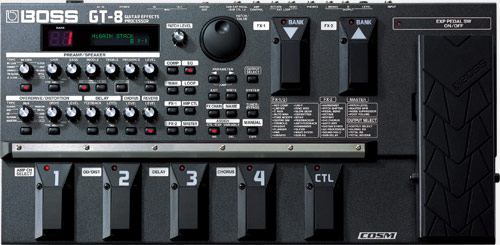
Given some brief research, the first to release such a "complete" unit have been Digitech with their RP-1 (no expression pedal, though, but that's something people not generally agree upon as a necessity). That was 92/93. Then there's been the GT-5 (96), followed by things such as the Korg ToneWorks AX1G (99), Digitech RP200 and what not.
These pretty much were the "role models" for that format, with the GT-5 likely being the first that was actually used in a more or less professional context by some players (in fact, a guy I know, killer player, has stocked 4-5 by now, so he's got spares until the end of his life), maybe this worked out so well because the drives and such were analog (the amps obviously weren't). I should actually take mine out one day and see how well it holds up in case I'd run it through a better cab sim...

Anyhow, the first complete floor modeler made by Line 6 only came out in 03, so that's a decade afrer the RP-1 and still 7 years after the GT-5.

Apart from the improved sonic qualities, pretty much any others were just UI improvements on the same theme. And as said, it's a logical evolution anyway.

Sascha it all depends on how close you want to zoom on the technology map. If you look at guitar devices there are some first (being line6, boss, fractal, is not important) but if you zoom out you find things that existed for years or decades in other markets.

The signal path rapresentation was present in keyobars since the 90s? yes.
the signal path, with color coded icons used in the helix, though, took the concept and made it basically a standard everyone else wanted to adopt.

was the dynamic color coding used for the swithes a new concpet? of course not. was it new in the context of floor modellers? I don't know, honesly, but probably yes.

or the capacitive switches. capacitive faders and knobs are present in mixing desk since forever but no one (afaik and I know little) line6 put those on a floor unit first (afaik, again).

is the showcase feature that will be available in the Helix Stadium a new concept?. Not at all.
Is it a first in the guitar modelling world that will shift the concept of floor uniit from guitar devices to worksations forever? yes it is.
is the workstation concept new? no it's not, keaboards have been workstations since forever.

does all of this really matter?

not very much, imho.
 
While I wait for my XL to arrive, I’d figure I’d ask the experts here about stereo/mono thing:

I’m planning on using stadium as a wired iem solution. With the individual mixes available, I should be able to get band mix in and balance that with my own mix.

Question: can I have my stereo mix going out from the HP output but send a mono signal out by only using the L/Mono output of the xlr? Or would that sound weird? I’ll experiment for sure, but just wondering. It would be nice to listen to reverbs and delays in stereo (I’m using iems)
 
Question: can I have my stereo mix going out from the HP output but send a mono signal out by only using the L/Mono output of the xlr? Or would that sound weird? I’ll experiment for sure, but just wondering. It would be nice to listen to reverbs and delays in stereo (I’m using iems)

Been doing that for a while (not with the Stadium of course, also arranged my monitoring using a small mixer) but ultimately decided it was a better idea to have the same sound on my IEMs that the audience (and anyone else involved) would listen to.
For 3 (I think) gigs I did however try to have a little ambience applied to just my monitoring signal (I'm typically playing bone dry rhythm tones, so they can end up feeling *very* direct through IEMs), but while it worked quite well, I had to bring an external reverb unit for that adventure (no onboard reverb in my small IEM mixer), so I just stopped doing so.
Add to this that sometimes I just need to use the supplied wireless IEM system, so I rather have the same conditions all the time.
 
Been doing that for a while (not with the Stadium of course, also arranged my monitoring using a small mixer) but ultimately decided it was a better idea to have the same sound on my IEMs that the audience (and anyone else involved) would listen to.
For 3 (I think) gigs I did however try to have a little ambience applied to just my monitoring signal (I'm typically playing bone dry rhythm tones, so they can end up feeling *very* direct through IEMs), but while it worked quite well, I had to bring an external reverb unit for that adventure (no onboard reverb in my small IEM mixer), so I just stopped doing so.
Add to this that sometimes I just need to use the supplied wireless IEM system, so I rather have the same conditions all the time.

Fair point. Quite a few songs have some subtle delay on, so I’d guess that’s enough. I guess I could make a path to hp with a ambience reverb to cushion the sound a bit when playing more “dry” rhythm.

First idea was letting the stereo collapse to mono, but that brute force approach might not work. I have plenty of paths to work with tho!
 
So lets go wayyyyyy back for some old "cutting edge" equipment, some of which are mostly analog while
others are digital. So even the so-called great Sascha the Bumbler is wrong since there was a time
when Ibanez had the corner on "multi effects" guitar "processors". LoL!

Owned this in the late 70's/early 80's

Ibanez UE300 Multi Effects analog.jpg


Owned this in the late 70's/early 80's

Ibanez UE400 Multi Effects analog.jpg


Owned this in the 1990's
ART-SGE-Mach-II-Multi-Effects-Processor_1629467819_3704.jpg


Owned this in the 1990's

ART SGX-2000.jpg


Owned one of these, too...

Digitech RP7 Valve.jpg


Never owned one of these (supposed to be 3 channels).

The Chase Bliss Audio Preamp MKII.jpg
 
So lets go wayyyyyy back for some old "cutting edge" equipment, some of which are mostly analog while
others are digital. So even the so-called great Sascha the Bumbler is wrong since there was a time
when Ibanez had the corner on "multi effects" guitar "processors". LoL!

Owned this in the late 70's/early 80's

View attachment 56405
First produced in 1980. Perhaps Ibanez coined the term "Multi-Effects"? Cool.
 
First produced in 1980. Perhaps Ibanez coined the term "Multi-Effects"? Cool.
However, I would NEVER take away from the serious major impact that Line 6 had from the original amp and the POD through Stadium!

I have owned a LOT of tube amps, too, but I remember the Spider Valve (Bogner) amp well that I owned for several years!
Point being (and aligned with yours) that their is some ugly fish pic that just never gives up, even when proven to just ramble on
and move the goalposts on every missed kick in forums!

I'm a Fractal dude that has owned everything under the sun and own two of their top of the line products while simultaneously owning
the Helix Stadium XL (and a former owner of OG Helix and tons of Line 6 products over the years. Was really fond of my Vetta
with the control pedal for it!) Eventually used OG Helix as a backup when I got my Axe FX III and didn't get rid of it until
FM9 came out and kept the Helix for a year longer after purchasing the FM9.

I'm done with this!
 
Last edited:
First produced in 1980. Perhaps Ibanez coined the term "Multi-Effects"? Cool.
That was 3 years after I got my first electric, an original Peavey T-60.
They were ridiculed for rigging up those "programmable" machine tools to make those guitars.

Now everyone, except for small luthiers (or special limited edition lines), is using CNC type machines
to build even very high priced bling guitars.

Innovation and borrowing tech to make life easier is a beautiful thing! (not talking about patents and copyrights being broken)
 
Last edited:
So lets go wayyyyyy back for some old "cutting edge" equipment, some of which are mostly analog while
others are digital. So even the so-called great Sascha the Bumbler is wrong since there was a time
when Ibanez had the corner on "multi effects" guitar "processors". LoL!

Owned this in the late 70's/early 80's

View attachment 56405

Owned this in the late 70's/early 80's

View attachment 56406

Owned this in the 1990's
View attachment 56407


Owned this in the 1990's

View attachment 56408


Owned one of these, too...

View attachment 56409


Never owned one of these (supposed to be 3 channels).

View attachment 56410
That UE-300 is WILD. I remember in the late 90s people were chasing them down to harvest the old 4558 chips for their tubescreamers.
 
Ok, I'll join you in some memories....
(pictures are not mine)

when I was barley a teenager had one of these


1765820304597.png


And few years later, during the 90s, I bought this ART multi FX.

1765820375342.png


I used the ART for a long time and between 2000 and 2010 it was paired with the almighty POD 2.0 + Floorbord that served me so well in many occasions.
I used to send L pod out to the FOH and R to the ART for heavily eqing the marshall combo I used as personal stage monitor.

I used the pod so much for gigging that the red coating was missing in some parts. LOL
Loved that little bean.

1765820683705.png
 
Back
Top