splitting line level signal - what should I buy?

Messages
30
I have a stereo signal at line level that I wish to send to my Cranbourne Audio headphone amp. But I also need to send it to my interface for times when I need to record it.

It must be transparent and the ability to monitor via the headphone amp must still be optional even if I send the signal to the interface.

The Radial MC3 looked good, but it's discontinued.

Any suggestions would be greatly appreciated.
 
Balanced line level should split just fine, you can use a patchbay and have it half normalled to do the mult.

Per ChatGPT

It’s technically fine to split a balanced line-level signal on a patchbay because of how professional audio gear is electrically designed.


1. Line outputs are low impedance


Most professional line outputs have an output impedance around 50–200 ohms. This means they can deliver signal easily without being affected by what they are connected to, within reason.


2. Line inputs are high impedance


Line inputs are typically 10,000 ohms (10 kΩ) or higher. High impedance inputs draw very little current from the source.


3. Splitting does not overload the source


When you split a signal to two inputs, those input impedances are effectively in parallel. For example:


Two 10 kΩ inputs in parallel = 5 kΩ total load.


Even 5 kΩ is still vastly higher than a 100 ohm output impedance. This large ratio (50:1 in this example) means:


• The source is not stressed


• Signal level remains effectively unchanged


• Frequency response is unaffected


This is called impedance bridging. Modern audio systems are designed around this concept.


4. Balanced connections remain balanced


A balanced output drives two signal conductors (+ and –) plus ground. When you split the signal, both conductors are still duplicated equally. This preserves:


• Noise rejection


• Common-mode rejection


• Signal symmetry


So you do not lose the benefits of balanced wiring by splitting passively.


5. Why this is specific to line level


Line-level outputs are active, buffered circuits. They are meant to drive multiple loads.


Instrument pickups and some vintage gear are passive, high impedance sources. Splitting those does cause level loss and tonal change. That is a different electrical situation.

l

When splitting can cause issues


Rare but possible cases:


• Very old or unusual output designs


• Unbalanced outputs into multiple destinations


• Extremely long cable runs


• Ground loop problems


But with modern professional equipment, passive multing on a patchbay is standard practice.
 
A good patch bay is great, but they're fairly expensive, and you probably don't need a 96 point TT bay with selectable mults or normalling for what you're planning.

I don't know whether this device sounds perfect or not. I haven't used one. However, Vintage King is an excellent outfit that equips a lot of pro studios in LA, Nashville and Detroit, and can probably tell you. I've bought from them for 20 years.

For stereo sources, I believe you'd need two of these.

 
why would it need to be an expensive one? A cheaper TRS patchbay would be just fine for what OP needs to do.
Weird taking that out of context, when what he really said was: "and you probably don't need a 96 point TT bay with selectable mults or normalling for what you're planning." :unsure:
 
Weird taking that out of context, when what he really said was: "and you probably don't need a 96 point TT bay with selectable mults or normalling for what you're planning." :unsure:
Nah, read it again. He is saying a good patchbay is expensive so he shouldn’t go that route and recommended those radial boxes. I’m saying in response that it doesn’t need to be an expensive patchbay.

Expensive patchbays are great, but for home use you don’t need the fancy stuff. A commercial studio that’s dealing with tons of people coming and going and all on expensive rates, you don’t want something failing on you. And you have other concerns that justify the costs. For simple home use stuff that gets used significantly less, TRS options are fine. They’d cost much much less than a pair of those radials and are probably more useful overall for combining various pieces of gear.
 
Thank you for your time, guys, I really appreciate the input. I am fairly new to the patchbay thing and need to learn more, but I didn't know they split signals (I expect someone will say "that's literally their job!"), I thought they were for moving signal from one device to another.

@László it was those Radial devices that caught my attention at first, but I got concerned about them being passive devices and loading the signal and causing signal degradation. But as @MirrorProfiles excellent first post points out, line level signals don't really suffer from this - well that's part of what I took from it anyway.

So the takeaway for me is to learn more about Patchbay's and don't yet discount the Radial's!
 
You'd basically have it like this:

Screenshot 2026-01-22 at 16.57.22.png

When you have no cables plugged in, the signal will just run straight to the headphone amp. If you wanted to have the signal go to the headphone amp, and to the line inputs, you'd just use 2 patch cables and you'd do 1->3 and 2->4. With it set up for half normalled operation, the signal will still flow as normal to the headphone amp and it'll also go to your inputs at the same time. If you had other gear on the patchbay you could easily run that into your inputs, or headphone amp, or send anything directly to the headphone amp.
 
Patchbays are much easier than in seems and Mirror Profile suggestion is correct.

Patchbays have a front and a back, in the back you connect your gear, in the front you route things around using patch cords (or internal routing)

And there are 2 rows: upper one is usually used for the sources (output signals coming from your gear), lower for the destinations (signals going to your gear).

When a patch bay is normalled the signal entering form the back goes directly down to the lower row (of the same column: 1 goes to 1, 2 goes to 2 and so on)
If you insert a patch cable in the front upper row you "steal" the signal (meaning it won't go to the lower row anymore) and you can move it wherever you need simply plugging the other side of the patch in a lower row hole.

1769108639044.png


When a patch bay is half normalled the signal entering form the back still goes directly down to the lower row but if you plug a patch cord in the upper row front, the singal will go both to the lower row and to the patch cord. There you have it, a spitted signal.

1769108812889.png


Patch bays can also be non normalled. in this case the signal won't go anywhere unless you use a patch cord to move it around.
 
You'd basically have it like this:


When you have no cables plugged in, the signal will just run straight to the headphone amp. If you wanted to have the signal go to the headphone amp, and to the line inputs, you'd just use 2 patch cables and you'd do 1->3 and 2->4. With it set up for half normalled operation, the signal will still flow as normal to the headphone amp and it'll also go to your inputs at the same time. If you had other gear on the patchbay you could easily run that into your inputs, or headphone amp, or send anything directly to the headphone amp.
This is brilliant, so essentially, I could run a CD/Player or even a dedicated output from my interface to run a drum track into the headphone amp too, so I can play along. The "DAC Line out" in your diagram is basically a stereo feed from the last pedal in my 'post-amplifier & speaker' FX chain.
Patchbays are much easier than in seems and Mirror Profile suggestion is correct.

Patchbays have a front and a back, in the back you connect your gear, in the front you route things around using patch cords (or internal routing)

And there are 2 rows: upper one is usually used for the sources (output signals coming from your gear), lower for the destinations (signals going to your gear).

When a patch bay is normalled the signal entering form the back goes directly down to the lower row (of the same column: 1 goes to 1, 2 goes to 2 and so on)
If you insert a patch cable in the front upper row you "steal" the signal (meaning it won't go to the lower row anymore) and you can move it wherever you need simply plugging the other side of the patch in a lower row hole.


When a patch bay is half normalled the signal entering form the back still goes directly down to the lower row but if you plug a patch cord in the upper row front, the singal will go both to the lower row and to the patch cord. There you have it, a spitted signal.


Patch bays can also be non normalled. in this case the signal won't go anywhere unless you use a patch cord to move it around.
Prior to reading this, I asked ChatGPT how it all worked and I made vague sense of it. But after reading your post and @MirrorProfiles explanations, it makes a lot of sense now. Thanks for clarifying the normalled modes, that helps a lot.
 
Back to the ordinal question..

What interface are you using?

I would patch the stereo mix into my interface and use a pair of the outs to go to the headphone amp.

Then just mute the interface when not recording so it's only passing the input to the headphone amp.

This would be using the interface as a patch bay. You wouldn't have to buy anything
 
Back to the ordinal question..

What interface are you using?

I would patch the stereo mix into my interface and use a pair of the outs to go to the headphone amp.

Then just mute the interface when not recording so it's only passing the input to the headphone amp.

This would be using the interface as a patch bay. You wouldn't have to buy anything
Very much is on my radar, @Sleezy E , but the issue is that currently my interface only works when I switch the Mac on and the whole ethos behind my approach relies on not having to do that. I could power it and avoid USB power, I guess, but there is only XLR outputs and a headphone out, thus wasting the few outputs I have on it (RME babyface pro). So doing that complicates things for me more than a simple splitter like a Lehle P-Split stereo or a patch bay would.

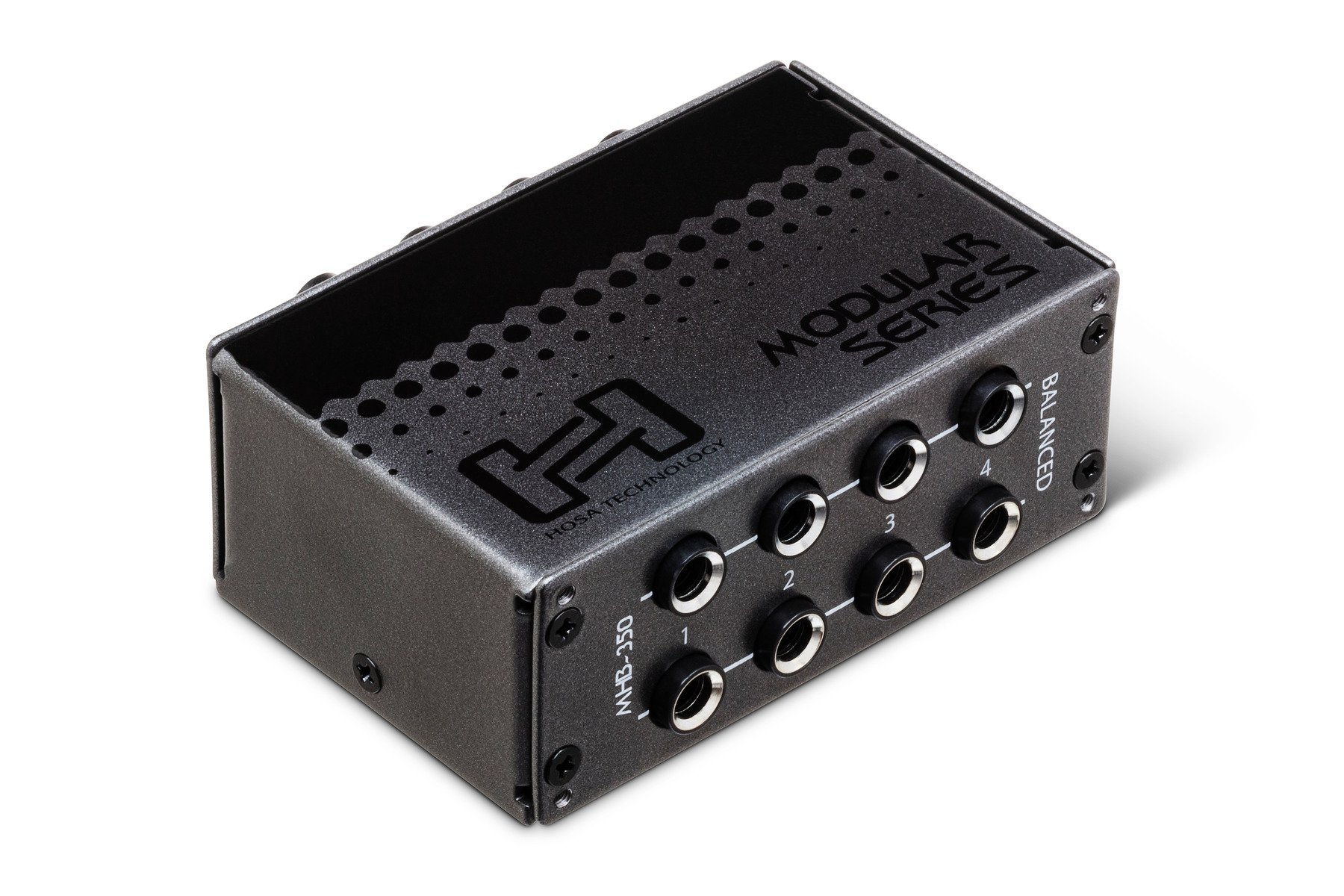
My current battle is with having to import a HOSA (because I don’t need a 19” rack full of mostly holes, for this purpose…or just get a neat solution like the P-Split stereo and done.
 
Back
Top