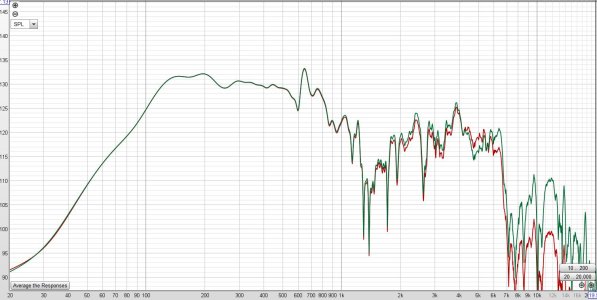
OK, I’ll bite. You guys tell me if I’m completely goofy or not, and if I am, it won’t hurt my feelings.
I still use one of Jay‘s 412 IR captures quite often. At times I find that it doesn’t have enough high-end for what I’m using it for. So I apply an EQ and get the high-end that I need for the particular track or sound. I find that to be easier and actually sound a lot better in most cases than searching for a different IR.
Is that stupid?
No. I think you should find an IR (or set of IRs) that at least mostly gets the sound you want, just like you'd try to get most of the sound irl by choosing mics and mic positions, but that a lot of frustration over "finding the perfect IR" (or the perfect speaker) can be solved with a little post EQ and maybe some clipping, which is also standard practice in any actual mixes.
Outside of some specific cases with either less picky or more experienced engineers, basically all of the recorded guitar tracks you hear are EQ'd after being recorded from mics: sometimes just a little bit, and sometimes
heavily EQ'd in ways that would probably offend some guitarists lol. With IRs, you're giving up a certain degree of control that those experienced engineers have anyway, even if you can mitigate that with things like the DynaCabs and Helix's cab engine, or by having a large collection of IRs. I don't think there's any reason to limit yourself further by removing post EQ, another commonly used tool, from your toolbox too.
As with all of these things, just try to get fairly close to your intended sound (or at least move in that direction) at each step along the way so you're not
having to do extreme processing at the end of your chain. It's the difference between, say, a little post EQ and IR filtering like James Santiago was doing in nearly every preset he did in that long UA Paradise Studio demo and how some YouTubers will tell people to layer 2 pre-eqs, 3 post-eqs, filtering in the cab block, global EQ tweaks, and 2 stages of post-compression in a modeler just to get a "good sound" lol