Realistic reverb is crap

I was reading a post on Reddit a few months back by a non-musician who was fascinated with the studio world and I initially knee-jerked to his depiction of recorded music, essentially saying it’s all a lie and nothing what you hear actually sounds like that in the room. Once my knee was done jerking I couldn’t disagree, even if you’re doing just basic lo/hi cuts, it’s still not a representation of what was in the room.

And I’ve long been saying that vocals are a shitload of smoke and mirrors of mic gain, compression and reverb that give the idea someone is considerably louder than they actually are, for years. So many vocal tracks that sound like they’re being belted out at a blaring volume are barely above speaking level, but with enough drama in the performance and enough reverb to sound like a voice is bouncing off the walls and it sounds quite different.

i think that capturing an incredible live and live sounding performance IS possible.. but i haveta say that its seldom JUST the tracks as they hit tape. even classical music or live jazz gets worked on between mic and pressing multiple times.
 
i think that capturing an incredible live and live sounding performance IS possible.. but i haveta say that its seldom JUST the tracks as they hit tape. even classical music or live jazz gets worked on between mic and pressing multiple times.

I've record and mixed several times orchestras, string quartets or jazz bands (live on location and in studio) and even if there's a lot of editing and audio manipulation involved, most of the times everything is done in a very natural way.

It’s a very different approach compared to the one used in pop/rock discography.
 
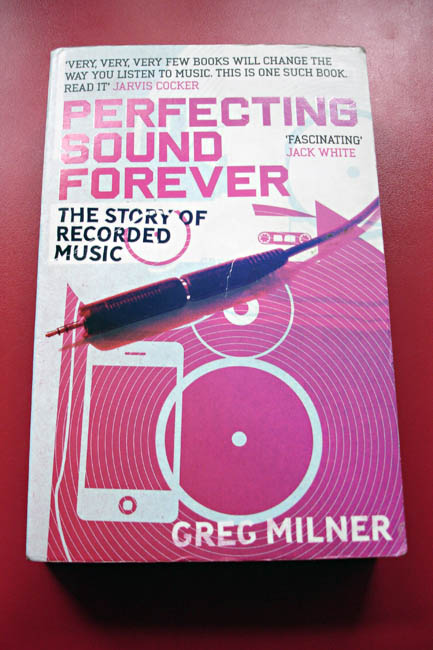
This is such a GREAT book on the history of captured/created sound and the differences
in approaches over the past 150+ years or so. It is freaking brilliant, and has totally
shaped the way I see recorded music. The recorded music that is no such an abstraction
that it has come to infect, infiltrate, and inspire what happens with actual live music.

Perfecting-Sound-Forever.jpg


The synopsis is that early recorded music fooled listeners into thinking
it was being performed live. There are tales of tricking entire audiences
that were in utter disbelief. Of course, we listen now and we think an
early etched recording on a Grammaphone is trash.
:LOL:

Later, recording music became more of a laboratory experiment to see
what new sounds could be created that did not exist in the natural world.
We are VERY much still neck deep in that phase. For good, and for ill. :idk

For instance, much of the low-end and subharmonic bass we hear plastered
all over recorded music (and which is nigh unto impossible to recreate live
without some serious wattage and massive arrays!) maybe only exists naturally
in thunderstorms, nuclear explosions, and volcanic eruptions.
:rofl

Another funny insights are all these interstellar reverbs with infinite decay being
deemed synonymous with space and stars and supernovae. Yet, an astrophysicist
will tell you space is more like a vacuum and the deadest room at the Inn you
could ever not hear in your life. :unsure:

Shoutout to @State of Epicicity for suggesting that book to me a few years ago.
:beer
 
This is such a GREAT book on the history of captured/created sound and the differences
in approaches over the past 150+ years or so. It is freaking brilliant, and has totally
shaped the way I see recorded music. The recorded music that is no such an abstraction
that it has come to infect, infiltrate, and inspire what happens with actual live music.

Perfecting-Sound-Forever.jpg


The synopsis is that early recorded music fooled listeners into thinking
it was being performed live. There are tales of tricking entire audiences
that were in utter disbelief. Of course, we listen now and we think an
early etched recording on a Grammaphone is trash.
:LOL:

Later, recording music became more of a laboratory experiment to see
what new sounds could be created that did not exist in the natural world.
We are VERY much still neck deep in that phase. For good, and for ill. :idk

For instance, much of the low-end and subharmonic bass we hear plastered
all over recorded music (and which is nigh unto impossible to recreate live
without some serious wattage and massive arrays!) maybe only exists naturally
in thunderstorms, nuclear explosions, and volcanic eruptions.
:rofl

Another funny insights are all these interstellar reverbs with infinite decay being
deemed synonymous with space and stars and supernovae. Yet, an astrophysicist
will tell you space is more like a vacuum and the deadest room at the Inn you
could ever not hear in your life. :unsure:

Shoutout to @State of Epicicity for suggesting that book to me a few years ago.
:beer
isn’t there something about the development of tape machines being a Nazi trick to fool the allies into thinking they were doing big speeches or performances in random locations and at weird times of the day? A bit sad how much of modern music recording equipment comes directly from war.

Lovely to see you back posting again here @la szum . Hope all is well!
 
isn’t there something about the development of tape machines being a Nazi trick to fool the allies into thinking they were doing big speeches or performances in random locations and at weird times of the day? A bit sad how much of modern music recording equipment comes directly from war.

Lovely to see you back posting again here @la szum . Hope all is well!

Oh man! What doesn't?
:facepalm


War is such a massive driving force for innovation, deception, and design. It's bonkers. This
Planet must be ruled by Mars or something. :idk

Thanks, Ed! Happy Holidays, and hope all is well on that side of the Pond.
:beer

And yes, Germany and BASF. Not unlike the interconnected devices we are communicating
to one another on right now. Thank you Warring Overlords!
:LOL:


Ok, probably not funny..... but pretty accurate. :idk
 
I'm one of those outliers, I guess. I don't even own an amp with reverb. Haven't in 15 years or so. I found I used it as a crutch. I had a gig coming up and the reverb on my amp quit. After that, no more reverb.

I do like the sound of reverb for sure. Shit I saw Dick Dale in concert.
 
Oh man! What doesn't?
:facepalm


War is such a massive driving force for innovation, deception, and design. It's bonkers. This
Planet must be ruled by Mars or something. :idk

Thanks, Ed! Happy Holidays, and hope all is well on that side of the Pond.
:beer

And yes, Germany and BASF. Not unlike the interconnected devices we are communicating
to one another on right now. Thank you Warring Overlords!
:LOL:


Ok, probably not funny..... but pretty accurate. :idk
Actually BASF is a chemical Company that Developer the magnetic tape with it’s Inventory, the tape machine was done by AEG. An Electronics Company.

The whole thing was really only useable the way we think of it after Ampex improved on it post WW2.
 
Yet, an astrophysicist
will tell you space is more like a vacuum and the deadest room at the Inn you
could ever not hear in your life. :unsure:
I've made this point several times over the years. It is funny though because it's where our mind tends to go when we hear spacious reverbs. I suppose blame it on early UFO and sci-fi themes on radio, with the use of spring and plate reverbs.
 
It is slowly dawning on me, and maybe I'm alone here, but I don't like realistic reverb. Particularly on guitar, but in general.

realistic reverb tries to put your guitar somewhere, but artsy cinematic atmospheric reverb turns your guitar into something.

Sonically, I'm not very interested in answering the question "where is the sound happening?" I'm more interested in answering the question "what if?"

I'm trying to shape tone, emotion, and movement. I'm not trying to pretend I'm in some Philharmonic setting, or that my recording was exactly and precisely 6metres from the rear wall of Cuck Studios, Florida.

Guitar is already an abstraction. It is already fake. Adding realistic space to that just feels conceptually wrong to me. I don't want realism. I want impact.

Led Zep found a stairwell they could record drums in, then they crushed the living shit out of the recordings with a compressor. It is the abstraction and the combination of processing that makes that sound literally a world class, genre defining, music defining recording:


That isn't real. At all. But it is fucking amazing.

Same opinion here. I don’t like or seek realistic reverb at all for my guitar stuff. Guess I’m a post rock ambient type of person and placing the guitar “in” a space is not relevant, because I want the effect to be the instrument. I do the same with delay. Some like it subtle to embellish notes, and not interfering with the guitar playing whilst I like it to controll my playing letting become an instrument of sorts.

for recording I would place other dry instruments in some kind of room/space. But guitars wouldn’t need it.
 
There's moments where I head straight for a drippy Fender-style spring reverb, be it pedals or onboard tanks.

Also, I have a love/hate relationship with the built-in reverb of my Ampeg VT-22. Nothing sounds quite like that one, but the murky construction and overall "troubles" that come with playing that behemoth of an amp prevent everyday use, especially since we're still living in an apartment building.

The Subdecay Super Spring Theory is my favorite reverb pedal, although lately I'm finding myself gravitating towards its "room" mode rather than the spring, since it's less invasive and sounds more like what I want from a reverb in a band mix.

Not sure, maybe I'm just going through a weird patch here... 🤷‍♂️
 
The only type of semi-realistic space type reverbs I like are small room sounds. They do a similar thing though of making your guitar sound into “something” rather than “somewhere”.

Reverbs are all about the vibes for me. I don’t go subtle with them, I’m trying to really get some attention with them and do something interesting.

I’ve never once turned on a reverb pedal that I liked and questioned whether or not it really sounded like a great physical hall. As a matter of fact, I don’t think any of my favorite reverb sounds actually sound anything like typical physical space.

D
 
Reverbs are all about the vibes for me. I don’t go subtle with them, I’m trying to really get some attention with them and do something interesting.
Nicely put, thanks! Can't wait to pick up the guitar tomorrow and see where your advice leads me.
 
I agree. For guitar, I want a very realistic room sound for certain contexts, but outside of that I mainly want characterful reverbs that don’t sound like a real space, and about half the time in front of the amp. It’s actually something I’ve struggled with a bit with Fractal, which nails the realistic room part, but the other stuff doesn’t seem to come naturally… even though there are probably ways to coax these sounds out (I haven’t messed with it much yet outside of presets and basic settings tbf!), and I do like the plates.
 
Fractal Audio:

"Our friend should talk to David Griesinger. He probably knows more about reverb than everyone else combined. He's the father of the Lexicon reverbs. According to him, and I have no reason to doubt him, real reverb (i.e. reverb from a real space) is actually inferior to synthetic reverb. This is due to human perception. Real reverb (and by extension convolution reverb) actually reduces intelligibility and clarity due to the particular nature of the decay, the decay being exponential. Synthetic reverb allows one to craft the decay curve thereby rendering improved clarity. If the decay curve is flat for a period and then exponential it doesn't clutter the desired program material. The new reverb algorithms in the Axe-Fx are based on his theories."

 
Back
Top