Andy Eagle ( Guitar repair tech for 30 years )

I saw an older thread about plek and you gave your thoughts…do you still have the same opinion? I know for example suhr quit using them and claim their own way is better but of course I’m a bit dubious of a claim like that
I haven’t read why John stopped using it. Post it I would be interested. I fail to see why a different process could improve on it . It is a tool though and subject to the intention of the operator. I suspect it’s more about being a blockage in the production line. In fairness to John if you start out with a stable straight piece of wood with evenly pressed frets it’s not going to be doing much and certainly not what it excels at.
For me Plek is a repair tool for the analysis and correction of issues in an instruments fingerboard geometry using actual data. But almost nobody utilises this capability fully.
 
What is your opinion on Luxxtone (Choppa S) guitars, if you have run into them? Do you know what SS fret wire they use, and how their own pickups sound?
 
What is your opinion on Luxxtone (Choppa S) guitars, if you have run into them? Do you know what SS fret wire they use, and how their own pickups sound?
I’ve set up four or five and they are very good. I think the wire is Jescar. Fender custom shop quality. Pickups; I can’t really comment because I only played them through my bench amp ( tech 21 Trademark 10).
 
I haven’t read why John stopped using it. Post it I would be interested. I fail to see why a different process could improve on it . It is a tool though and subject to the intention of the operator. I suspect it’s more about being a blockage in the production line. In fairness to John if you start out with a stable straight piece of wood with evenly pressed frets it’s not going to be doing much and certainly not what it excels at.
For me Plek is a repair tool for the analysis and correction of issues in an instruments fingerboard geometry using actual data. But almost nobody utilises this capability fully.
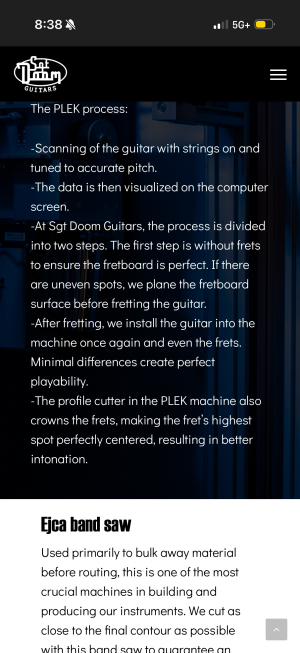
I will find the suhr post, but in terms of using it fully, would this post be using it fully with the two step process? (Had to attach because too large on my phone).

But I get why it’s not fully being used if most companies using it on new builds wouldn’t be using it to the max of its ability
 

Attachments

  • IMG_1357.png
    IMG_1357.png
    2.8 MB · Views: 19
I will find the suhr post, but in terms of using it fully, would this post be using it fully with the two step process? (Had to attach because too large on my phone).

But I get why it’s not fully being used if most companies using it on new builds wouldn’t be using it to the max of its ability
The thing to remember though is plek does do things empirically and can produce results that are near impossible by traditional methods. The geometry analysis and its ability to produce the “correct “ geometry in spite of anything negative happening due to tension or a less than optimal relief curve. An experienced and good tech ( few and far between) can get probably get similar feeling results but it will have taken a considerable time and experience. An understanding of fretboard geometry is sadly lacking beyond level with no tension and the use of the Stew Mac tension jig which definitely doesn’t replicate string tension geometry in practice.
If John uses quarter sawn timber only and it has uniform grain plek will not really have anything to do other than confirm it. The cost of the machine generally means that it is a bottle neck in production and there is your problem.
Other companies ( Gibson ) use it but only as a CNC fret dresser no use of the data to dail individual pieces. This unfortunately is the way it gets used 99% of the time.
There are several machines in the UK and only one is being used properly this is also true in the US .
Joe Glaser being the place to go for Plek in the US and Charley Chandler in the UK .
 
Last edited:
The thing to remember though is plek does do things empirically and can produce results that are near impossible by traditional methods. The geometry analysis and its ability to produce the “correct “ geometry in spite of anything negative happening due to tension or a less than optimal relief curve. An experienced and good tech ( few and far between) can get probably get similar feeling results but it will have taken a considerable time and experience. An understanding of fretboard geometry is sadly lacking beyond level with no tension and the use of the Stew Mac tension jig which definitely doesn’t replicate string tension geometry in practice.
If John uses quarter sawn timber only and it has uniform grain plek will not really have anything to do other than confirm it. The cost of the machine generally means that it is a bottle neck in production and there is your problem.
Other companies ( Gibson ) use it but only as a CNC fret dresser no use of the data to dail individual pieces. This unfortunately is the way it gets used 99% of the time.
There are several machines in the UK and only one is being used properly this is also true in the US .
Joe Glaser being the place to go for Plek in the US and Charley Chandler in the UK .
here's the Surhr reference:
1776915231275.png
 
here's the Surhr reference:
View attachment 61973
This is about smooth process. It will be fine as long as the wood is perfectly predictable. Simulating tension doesn’t produce the exact same result pushing is not pulling and no longitudinal force is present. John also uses a vintage rod so Ime this is a step backwards. Any piece of wood that isn’t uniform in flex will produce less than ideal relief and this will not be as good as plek .
 
How many times have you played a guitar that just doesn’t buzz however you play it? It has a percussive slap back if you dig in but absolutely no fizzle after? This is perfect level frets and a perfect relief contour. The guitars that have it are gold and you can’t really guarantee that by hand unless you are prepared to do multiple passes with strings on in between and have the skill to evaluate the results . Nobody is going to do this for anyone but themselves. On my guitars I can do this over several weeks playing it extensively in between tweaks. Some necks simply aren’t capable of doing it because the flex is not ideal or over time they always give in to pressure from compression and flex producing a gradual change in geometry.
My Hydra was perfect without touching it but it has an engineered neck. By that I mean multiple layers of different wood selected for stability, a non compressing truss rod , carbon reinforcement and an ebony fingerboard. It also has a six screw attachment and the thicker heel.
IMG_4661.jpeg

This doesn’t move and is perfectly predictable.
My Vigier was also perfect from the box.
IMG_3622.jpeg

The 10/90 neck is utterly ridged and totally predictable. My Aristides guitars too by the fact that they are not wood.
The first time I ever encountered this “perfect” neck was a Jackson custom made Soloist in the mid 80s I absolutely had to have it.
How often is this out there in the wild you may ask? Not many would be my guess. Does paying for a high end guitar guarantee it? No but it massively increases the chance. For me this is one of those things found in the last couple of percent that makes the difference in an exceptional instrument along with no dead spots and a musical resonance . Good luck finding one ( I have them all )🤣 Including my Suhr Modern which is the least modern guitar I own.

 
I reckon you'd like a few of mine Andy.

- Rubato Lassie (carbon fibre/richlite). No wood, precise engineering. Makes an Ibanez S look fat.
- Suhr Modern Pro. John knows what's good.
- Cilia Bellaurora & Renegade. Much like Suhr, Charles knows what's good.
- OG Ibanez RG 550. Action is stupidly low AND it's desert yellow. Win/win.
- Hamer Standard. Massive neck with the old trick of flipping the grain on the middle of a 3 piece neck. Felt like playing a coffee table though.
 
I reckon you'd like a few of mine Andy.

- Rubato Lassie (carbon fibre/richlite). No wood, precise engineering. Makes an Ibanez S look fat.
- Suhr Modern Pro. John knows what's good.
- Cilia Bellaurora & Renegade. Much like Suhr, Charles knows what's good.
- OG Ibanez RG 550. Action is stupidly low AND it's desert yellow. Win/win.
- Hamer Standard. Massive neck with the old trick of flipping the grain on the middle of a 3 piece neck. Felt like playing a coffee table though.
Absolutely and I am not saying most guitars are remotely bad but there are some that mostly through luck work perfectly. I really am taking that last tiny bit of icing on the cake, the bit that is not in the gift of the builder even. This is why I buy guitars opportunistically never blind unless I expect to return it.
 
Absolutely and I am not saying most guitars are remotely bad but there are some that mostly through luck work perfectly. I really am taking that last tiny bit of icing on the cake, the bit that is not in the gift of the builder even. This is why I buy guitars opportunistically never blind unless I expect to return it.
Yep, sometimes the natural variation or uncontrolled elements lean in juuuust the right direction.
 
Back
Top