
Andy Eagle ( Guitar repair tech for 30 years )

I saw an older thread about plek and you gave your thoughts…do you still have the same opinion? I know for example suhr quit using them and claim their own way is better but of course I’m a bit dubious of a claim like that
I haven’t read why John stopped using it. Post it I would be interested. I fail to see why a different process could improve on it . It is a tool though and subject to the intention of the operator. I suspect it’s more about being a blockage in the production line. In fairness to John if you start out with a stable straight piece of wood with evenly pressed frets it’s not going to be doing much and certainly not what it excels at.
For me Plek is a repair tool for the analysis and correction of issues in an instruments fingerboard geometry using actual data. But almost nobody utilises this capability fully.
 
What is your opinion on Luxxtone (Choppa S) guitars, if you have run into them? Do you know what SS fret wire they use, and how their own pickups sound?
 
What is your opinion on Luxxtone (Choppa S) guitars, if you have run into them? Do you know what SS fret wire they use, and how their own pickups sound?
I’ve set up four or five and they are very good. I think the wire is Jescar. Fender custom shop quality. Pickups; I can’t really comment because I only played them through my bench amp ( tech 21 Trademark 10).
 
I haven’t read why John stopped using it. Post it I would be interested. I fail to see why a different process could improve on it . It is a tool though and subject to the intention of the operator. I suspect it’s more about being a blockage in the production line. In fairness to John if you start out with a stable straight piece of wood with evenly pressed frets it’s not going to be doing much and certainly not what it excels at.
For me Plek is a repair tool for the analysis and correction of issues in an instruments fingerboard geometry using actual data. But almost nobody utilises this capability fully.
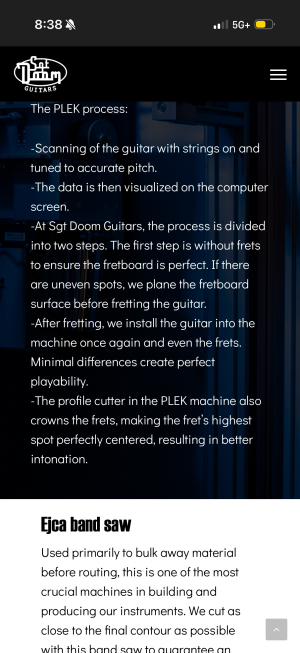
I will find the suhr post, but in terms of using it fully, would this post be using it fully with the two step process? (Had to attach because too large on my phone).

But I get why it’s not fully being used if most companies using it on new builds wouldn’t be using it to the max of its ability
 

Attachments

  • IMG_1357.png
    IMG_1357.png
    2.8 MB · Views: 10
I will find the suhr post, but in terms of using it fully, would this post be using it fully with the two step process? (Had to attach because too large on my phone).

But I get why it’s not fully being used if most companies using it on new builds wouldn’t be using it to the max of its ability
The thing to remember though is plek does do things empirically and can produce results that are near impossible by traditional methods. The geometry analysis and its ability to produce the “correct “ geometry in spite of anything negative happening due to tension or a less than optimal relief curve. An experienced and good tech ( few and far between) can get probably get similar feeling results but it will have taken a considerable time and experience. An understanding of fretboard geometry is sadly lacking beyond level with no tension and the use of the Stew Mac tension jig which definitely doesn’t replicate string tension geometry in practice.
If John uses quarter sawn timber only and it has uniform grain plek will not really have anything to do other than confirm it. The cost of the machine generally means that it is a bottle neck in production and there is your problem.
Other companies ( Gibson ) use it but only as a CNC fret dresser no use of the data to dail individual pieces. This unfortunately is the way it gets used 99% of the time.
There are several machines in the UK and only one is being used properly this is also true in the US .
Joe Glaser being the place to go for Plek in the US and Charley Chandler in the UK .
 
Last edited:
Back
Top