Just Ordered a JP15: Updated with NGD Post

OrganicZed

Shredder
Messages
1,061
I just placed an order for this fine looking guitar. I'm a big fan of JP's tone and playing, so these have been on my want to try list for years. Its a very feature rich guitar for the money when you compare it to other USA made offerings. I'll be quite interested to see how the workmanship (particularly the fretwork) stands up against my Tom Anderson, PRS, and Suhr guitars.

I've never played a JP15 before, but I figure I can send it back during the 30 day return window and eat the round trip shipping costs in the case that I just don't like it for some reason.

1777115265186.png


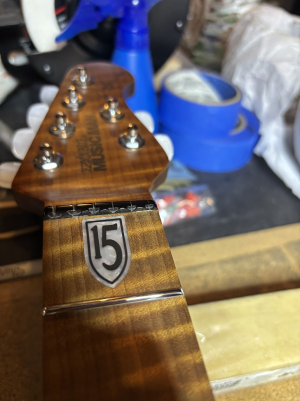
Oh, and here's a closeup so @TSJMajesty can scrutinize the string alignment and tell me if I picked a good one or not . :rofl

1777115496046.png
 
Ive had a JP15 , but in the cerulean blue. Was an absolute stellar instrument.
Could get the action just as low as my Tom Anderson with ease

I looked at several with the cerulean blue finish as well. It’s a lovely finish, but I have four blue guitars already and was looking for something different. The combination of the figuring on the top and neck of this particular example coupled with the purple nebula finish looks amazing IMO.
 
She’s a beaut.

That’s what I like about sweetwater - often m you get to at least look at the actual guitar you are getting.
 
So you are not unemployed anymore, I take it. :clint :LOL:

Congrats! Hope you dig it just as much when it arrives.
:beer
 
Until just the other day when I restrung my 20th Honey Butter Majesty with 11's so I could have a guitar tuned to D std, I'd been playing my JP15 for several months. It's just as nice as any of my Majesties, and maybe even a touch better in that the bridge cover sits a bit lower, which helps with palm mutes.

And it's nice that they're cheaper than a Majesty. I absolutely LOVE mine!

Congrats!!

And those strings look fantastic! You actually have a nice amount of room on the high e before the fret end turns down. Some of the Petrucci models don't have much room, even on ones that are centered, which "can" make it harder to do "finger rolls" when you're playing 2 or even 3 notes on the same fret.

I went on the EBMM site to see how they say to properly care for the Maple neck, so I just bought some Murphy's Oil Soap, and Tru Oil.
 
Come to think of it, it's probably the neck on the JP that makes it, dare I say..., don't hold me to it..., my favorite of the bunch.


1777146613936.png
 
Life Update:

I signed the papers to accept a new job today.

Celebrate Mr Bean GIF by Working Title


My title will be the same rank as I was on track to achieve either this year or next year at my old employer. Also, the base salary is 18% higher than what I had at my previous job.

The only real downside that I'm aware of at this point is the new commute is going to suck. Average one way commute times will be 1-1.5 hours.

Reveals Don Orsillo GIF


Thanks to those whom have offered emotional support and encouragement along the way. Today is a good day.

So you are not unemployed anymore, I take it. :clint :LOL:

Congrats! Hope you dig it just as much when it arrives.
:beer
 
I looked at several with the cerulean blue finish as well. It’s a lovely finish, but I have four blue guitars already and was looking for something different. The combination of the figuring on the top and neck of this particular example coupled with the purple nebula finish looks amazing IMO.
I have a super soft spot for purple guitars!
I have also had many many blue ones haha
 
The TL;DR is that it's a great guitar and is a keeper.

Here’s the full review for those interested in the ramblings of an internet stranger.

The photos from Sweetwater did a great job capturing the figuring in the neck and maple top. It looks equally good in person. I could find no flaws in the finish. The gloss has a perfect glass-like surface and the satin / oiled wood surfaces are silky smooth.

1777828604642.png


The oil finished roasted flamed maple neck is sleek. The flame on the neck and fretboard really adds a visual wow factor. As expected, it has a rather slim profile. I'm not overly picky when it comes to neck profiles, but anyone looking for a medium or large neck shape will not like this one. I haven’t taken measurements, but it feels much less substantial than either the Suhr Modern elliptical 0.8-0.85 neck or the Anderson even taper 0.78 - 0.85 necks that I have on some other guitars. It does not appear to have any taper to the neck thickness; it stays equally thin through the whole playing profile which is why I think it feels so diminutive. I have found it comfortable to play so long as I maintain good fretting hand posture.

1777828683619.png


The inlay work on the fretboard is very precisely done and looks nice and clean around the edges of the (admittedly cheesy) shield-shaped fret markers. The side dots, in contrast, look almost as if they were burned into the wood. Their edges are indistinct and the placement of some of them is a little off-center of the corresponding fret. They're fine from a functional perspective, but they look a bit out of place on a guitar otherwise executed with this degree of precision craftsmanship.

1777829173046.png


One of the few construction flaws I've found on the instrument is a small bit of excess glue squeeze-out visible from when they glued the nut in place. I was able to get most of it off by carefully scraping it with a hobby knife. There is still a small line of glue visible, but it is less obvious.

1777829008575.png


The stainless steel frets have a high polish and the ends are dressed in a way that I can't even feel them as I move my hand up and down the neck. The angle of the fret end bevel is more acute than that applied by Suhr and Anderson (but is similar to how PRS does their frets). This imparts a less obtrusive feeling in the hand, but it sacrifices some of the playable surface area. The strings are well spaced and I haven’t had them slide off the edge of the board, so it is a well executed configuration. The frets are 0.051 x 0.108 medium jumbos. I thought they felt smaller than that, but I measured them and they are as advertised. They feel noticeably smaller than the 0.057 x 0.110 jumbo frets on my Anderson and Suhr guitars. I attribute this distinct difference in feel mostly to the more aggressive beveling. They are tall enough that I can play without feeling the fretboard against my finger tips, so that is what really matters to me. I prefer the jumbo size, but these are also good. I checked the entire neck with a fret rocker and the only fret where I observed even a hint of movement was the 18th fret around the D, G, and B strings. That result is extremely impressive and is the most perfectly leveled frets I've seen from any manufacturer out of the box.

The compensated nut is cut a bit on the high side of what I like. I think that’s a safe choice considering you can easily reduce the nut height but it isn’t easy to make the nut taller. All of the nut slots are cut so that the action off of the first fret measures between 0.50 - 0.55 mm. I generally prefer the treble strings closer to 0.40 mm and the wound strings to be about 0.45 - 0.50 mm. I will probably bring those nut slots down a bit the next time I put on fresh strings.

Sweetwater shipped the guitar with what I consider to be medium action. It measured 1.5 mm at the 12th fret and 2.0 mm at the 24th fret on all strings. The neck relief measured at 0.004 inches at the 7th fret. The combination of the medium action and nearly perfect fret work yielded a very clear and acoustically loud sound with not even a hint of fret buzz. While that is a perfectly playable setup, I have gotten used to much lower action and it felt too stiff for my liking. I set it up to have tapered string height from 1.4mm at the 24th fret of the low E down to 1.2 mm on the high E. Even with the much lower action, every note rings clearly and I didn’t identify any notes that seem to lack sustain (dead notes). The guitar absolutely rips with this setup.

One thing I quickly noticed that I didn’t like was that the D string rang out quite loudly behind the nut. I could hear it coming through the amplified sound as well. It appears to be a common complaint online that the D and G strings ring sympathetically behind the nut on EBMM guitars. Thankfully, swapping on a new set of D’Addario 10-46 strings substantially reduced the severity of the issue. The G string now rings a bit, but not loudly enough to be heard in the amplified sound. EBMM sells a rubberized headstock string mute accessory for $5, so I grabbed one of those to silence the unwanted ringing completely.

The hardware is all of top quality. All of the pots and switches feel premium and reassuringly solid. The push - push controls are so much nicer to use than the typical push - pull style. Some of the tuning buttons on the Schaller locking tuners felt overly stiff when adjusting them, but that was easily remedied by loosening adjustment screws a bit. When putting on a new set of strings, I noticed that the lock nuts have a much finer thread than those in the Suhr and Anderson branded varieties that I’ve previously dealt with.

The bridge is a great design. It is responsive with a wide range of both up and down pitch bending. The tuning stability is excellent for a non-locking style and is easily on par with the performance of the Gotoh 510 I have on several other guitars. The factory configuration has three springs attached to the generously sized brass block. Two extra springs were included as accessories. I like that they thought to make every edge rounded so it feels smooth to the touch. The arm is the push-in type and it has an adjustable tension grub screw concealed on the block side of the unit. It is obvious that a fair bit of thought went into this component design.

In addition to the proprietary bridge design, there are several touches that speak to the high quality of the instrument. All of the back plates are metal (aluminum?) rather than plastic. The strap buttons have what appears to be a nylon washer rather than the typical felt washer. The black volume, tone, and piezo volume knobs are a proprietary shape and are made of metal with a smooth glossy finish that looks nice. They also added a textured rubber wrap to make them easy to use. The rubber wrap on my guitar has some oxidized areas almost as if the instrument were left in the sunlight for an extended period of time. Thankfully, these can be user replaced and are $6 as a set of three.

The custom fit Mono case that came with the guitar feels like it will afford ample protection from bumps, drops, crushing force,, and scrapes. I love that it has a specific cutout to accommodate the vibrato bar so you don’t have to take it off when putting the guitar in the case. It is nice and lightweight, but it is also very thick and kind of awkwardly shaped. The internal storage compartments are too small to do much with and I would have liked it if they included some back pack straps to allow carrying it that way also.

1777828788092.png
 

Attachments

  • 1777829065873.png
    1777829065873.png
    1.3 MB · Views: 7
Last edited:
Review continued (reached character limit for post!):


Tones:
I fired up my JP IIC+ preset on the Axe-FX III and the guitar immediately sounded glorious. Whether playing tight, high gain rhythms or using the neck pickup for syrupy lead sounds, It is very clear that this is the JP15’s raison d'être. Instant Petrucci tones. Switching to the middle position with the coil tap and a clean tone was also very satisfying. Adding the piezo sound to the clean tone adds sparkle in a pleasing way. The guitar has notably great sustain.

So it's a purpose built one trick pony, right? Wrong! It sounds equally great running into the 6CA7 plexi model setup for a rock’n roll crunch tone. Classic rock riffage sounds solid. The onboard active boost that can be engaged from the push - push on the volume knob is a killer lead boost with that amp model. Rolling down the volume and using either the neck pickup or middle pickup settings provides access to clean / bluesy tones.

I was initially underwhelmed by the piezo sounds. Running the piezo through some compression, parametric EQ, an acoustic tonematch IR, and some reverb didn’t sound nearly as inspiring as my PRS P22 does. I was a bit disappointed, but that wasn’t a deal breaker considering I intend to mostly use the magnetic pickup sounds. It turns out that simply putting fresh strings and doing a setup completely addressed that concern. It now sounds equally as good as the piezo sound of my P22 and can produce some very convincing acoustic guitar sounds.

I’ve still got a bit more tweaking to do before it is set up exactly how I want it, but I’m happy with how it sounds and plays currently. Considering there were a few minor issues out of the box (excess glue, oddly placed side dots, oxidized grips on the knobs, tuner buttons not properly adjusted), I can’t quite say that it is of equal quality as offered by Anderson, Suhr, and PRS, but it is very close. Most importantly, there are no issues with it functionally and it has superb fretwork that is easily on par with those manufacturers. Considering the feature set, the quality of the execution, and that it is made in the US, I think it represents a good value at the $3,749 asking price. I could easily see myself purchasing a 7 string version to go along with it.
 
Review continued (reached character limit for post!):


Tones:
I fired up my JP IIC+ preset on the Axe-FX III and the guitar immediately sounded glorious. Whether playing tight, high gain rhythms or using the neck pickup for syrupy lead sounds, It is very clear that this is the JP15’s raison d'être. Instant Petrucci tones. Switching to the middle position with the coil tap and a clean tone was also very satisfying. Adding the piezo sound to the clean tone adds sparkle in a pleasing way. The guitar has notably great sustain.

So it's a purpose built one trick pony, right? Wrong! It sounds equally great running into the 6CA7 plexi model setup for a rock’n roll crunch tone. Classic rock riffage sounds solid. The onboard active boost that can be engaged from the push - push on the volume knob is a killer lead boost with that amp model. Rolling down the volume and using either the neck pickup or middle pickup settings provides access to clean / bluesy tones.

I was initially underwhelmed by the piezo sounds. Running the piezo through some compression, parametric EQ, an acoustic tonematch IR, and some reverb didn’t sound nearly as inspiring as my PRS P22 does. I was a bit disappointed, but that wasn’t a deal breaker considering I intend to mostly use the magnetic pickup sounds. It turns out that simply putting fresh strings and doing a setup completely addressed that concern. It now sounds equally as good as the piezo sound of my P22 and can produce some very convincing acoustic guitar sounds.

I’ve still got a bit more tweaking to do before it is set up exactly how I want it, but I’m happy with how it sounds and plays currently. Considering there were a few minor issues out of the box (excess glue, oddly placed side dots, oxidized grips on the knobs, tuner buttons not properly adjusted), I can’t quite say that it is of equal quality as offered by Anderson, Suhr, and PRS, but it is very close. Most importantly, there are no issues with it functionally and it has superb fretwork that is easily on par with those manufacturers. Considering the feature set, the quality of the execution, and that it is made in the US, I think it represents a good value at the $3,749 asking price. I could easily see myself purchasing a 7 string version to go along with it.
Wow! Helluva write-up. You know me, so I'm really glad you like it! ;)

I know I've been real picky with my EBMM window-shopping ever since discovering the issue with my 20th Anniversary Majesty, but you looked that guitar over a lot closer than I've ever done with any of mine. I've probably never even looked at the side dots. Good for you. :beer

My tuners' turning feel varies from from one to another, but I never thought to adjust them equally. Maybe I will now.

One thing I absolutely love about EBMM's is that compensated nut. I use a version of sweetened tunings on the Axe Fx, and I swear that btw the 2, all the different voicings of chords sound closer in harmony than on any other guitars I own.

But one thing I'm not a fan of, and surprised you didn't mention it in your quite-detailed review, is how the saddles don't self-center the strings. I guess it's a trade-off of them being piezos, of that particular design. Are the saddles on your Piezo PRS the point where the signal comes from? How do they differ?

I became intimately aware of them with my first Majesty due to breaking the high e the 2nd day (and the 5th, and the 10th...) due to a burr somewhere, that I finally was able to eliminate with abrasive cord. (But I shouldn't have had to!) Otherwise, they may have slipped my eye like the fret markers did.

So when restringing, as I get a bit of tension on the string, I center it on the saddle, then finish tuning up to pitch. No big deal now, but it really surprised me at first.

Now we're JP15 bros, I spose. :cool: Congratulations!
 
I really dig my Rosewood fretboard, but I'm jealous of that neck of yours, and the fretboard! That wood looks killer! I've never played any guitar with a Maple one, so I'd love to compare them. Where you at? :rofl
 
Back
Top