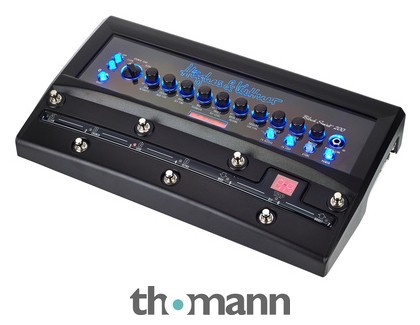
BluGuitar Amp X

I would think of the Amp X poweramp as more solid state than valve. IIRC nanotube is acting like phase inverter and the amplification is Class D. Preamp is solid state analog (like a typical pedal, or solid state preamp). I’m sure it sounds good and well optimised for the circuit but I’m also sure that people would have their preference and a decent valve poweramp would probably sound a bit better (with all its own usual downsides of cost/size/weight/reliability etc).
IIRC that tube is used for the negative feedback / interaction with the load; my Iridium feels awesome under the fingers.
I recently got one of those Harley Benton amp switchers and will try to sonically match the Iridium to some of my amps. The feel of the thing though is pretty darn good.
 
Even an FM3 + Poweramp takes that pricetag down a whole bunch and is basically equally capable.

I don’t think he is targeting the checklist feature set crowd. His passion seems to be about building his own dream gig amp, and the market for this are the people that align with his personal taste and approach. Whether that market is 7 people or 7,000 remains to be seen. :ROFLMAO:
 
I don’t think he is targeting the checklist feature set crowd. His passion seems to be about building his own dream gig amp, and the market for this are the people that align with his personal taste and approach. Whether that market is 7 people or 7,000 remains to be seen. :ROFLMAO:
1,000%

I think it’s more like, “hey, you want a LOUD 100 watt amp, that sounds and feels great, but without tube gremlins, and want it to fit on a pedalboard? Here you go.”

He’s sticking to a few core tones, not trying to give you everything.
 
Apologies if this has been explained before as I haven't always followed too closely.

When this is reconfiguring circuits, how exactly is it accounting for the lack of valves in these circuits? Like, it obviously has to approximate the behaviour of each gain stage using solid state tech, but that strikes me as something you can't easily do like for like. And even if you approximate one configuration, a valve with different voltages, resistors, impedances caps etc in another circuit is going to have its own quirks. The nanotube in there isn't involved in this part of the circuit, its doing something else AFAIK.

So a lot of what actually makes sense in the original circuit isn't just going to translate over to a solid state interpretation. Same goes for voltages, obviously this is running at a much lower voltage than most of the amps its approximating, and its something else that would require deviating from the original circuits to accommodate.

So when the gimmick of this is the ability to reconfigure the circuit to match amps, I don't really see how thats possible. It can reconfigure into amps that might sound and behave like those well known amps but I'd be more concerned if the circuits are close to the originals than not.

The other thing that's been on my mind is we've had products like this before which don't ever really take off with the public. Im not sure the reason why has ever been to do with how they sound, or how close the sounds it produces are to particular reference amps. They're absolutely nice things to have, and a good direction to go in, but I dont see that being the thing that turns something like this into a success:


Apologies if this has been explained before as I haven't always followed too closely.

When this is reconfiguring circuits, how exactly is it accounting for the lack of valves in these circuits? Like, it obviously has to approximate the behaviour of each gain stage using solid state tech, but that strikes me as something you can't easily do like for like. And even if you approximate one configuration, a valve with different voltages, resistors, impedances caps etc in another circuit is going to have its own quirks. The nanotube in there isn't involved in this part of the circuit, its doing something else AFAIK.

So a lot of what actually makes sense in the original circuit isn't just going to translate over to a solid state interpretation. Same goes for voltages, obviously this is running at a much lower voltage than most of the amps its approximating, and its something else that would require deviating from the original circuits to accommodate.

So when the gimmick of this is the ability to reconfigure the circuit to match amps, I don't really see how thats possible. It can reconfigure into amps that might sound and behave like those well known amps but I'd be more concerned if the circuits are close to the originals than not.

The other thing that's been on my mind is we've had products like this before which don't ever really take off with the public. Im not sure the reason why has ever been to do with how they sound, or how close the sounds it produces are to particular reference amps. They're absolutely nice things to have, and a good direction to go in, but I dont see that being the thing that turns something like this into a success:


Those H&K amps sound like ass. So that probably doesn't help. The Amp1 stuff sounds WAY better, IMO.
 
I mean, for literally 5x the price better do.

Aren't the core ingredients of it pretty similar? Just that the Amp X has better sounding (and more adaptable) circuits?
Well, I'm referring to the regular Amp1 stuff, which isn't 5x the price. The Amp1 Iridium is $900, the Spirit 200 is $1169.
 
Well, I'm referring to the regular Amp1 stuff, which isn't 5x the price. The Amp1 Iridium is $900, the Spirit 200 is $1169.
We can use those as an example and my point is the same really. I don't really see how Amp X is going to bring in a bigger audience. I can imagine most of its appeal would be existing Amp1 users who want other amp sounds and see it as more economical or practical than buying several of them. I sort of struggle to see how AmpX is going to be the thing to bring people into the ecosystem.
 
We can use those as an example and my point is the same really. I don't really see how Amp X is going to bring in a bigger audience. I can imagine most of its appeal would be existing Amp1 users who want other amp sounds and see it as more economical or practical than buying several of them. I sort of struggle to see how AmpX is going to be the thing to bring people into the ecosystem.

Oh I agree. That’s why the AmpX at its pricing has never been appealing to me.
 
Apologies if this has been explained before as I haven't always followed too closely.

When this is reconfiguring circuits, how exactly is it accounting for the lack of valves in these circuits? Like, it obviously has to approximate the behaviour of each gain stage using solid state tech, but that strikes me as something you can't easily do like for like. And even if you approximate one configuration, a valve with different voltages, resistors, impedances caps etc in another circuit is going to have its own quirks. The nanotube in there isn't involved in this part of the circuit, its doing something else AFAIK.

So a lot of what actually makes sense in the original circuit isn't just going to translate over to a solid state interpretation. Same goes for voltages, obviously this is running at a much lower voltage than most of the amps its approximating, and its something else that would require deviating from the original circuits to accommodate.

So when the gimmick of this is the ability to reconfigure the circuit to match amps, I don't really see how thats possible. It can reconfigure into amps that might sound and behave like those well known amps but I'd be more concerned if the circuits are close to the originals than not.
Blug's team will figure out how to replicate the behavior of the tube amp with their tech, then test it by ear and measure it in comparison to the real amp. When they feel it's spot on, they release the new amp. This isn't much different process from how digital modeling companies make their models, just instead of DSP it's digital control to tell the analog components what to do.

Most tube amps are built from the same building blocks and not that unique.

The other thing that's been on my mind is we've had products like this before which don't ever really take off with the public. Im not sure the reason why has ever been to do with how they sound, or how close the sounds it produces are to particular reference amps. They're absolutely nice things to have, and a good direction to go in, but I dont see that being the thing that turns something like this into a success:


Even though it's about the size of a FM9, its design makes it look massive. It's a pretty ugly box. I think the feature set is actually pretty cool but the tones just don't impress. I don't know wtf H&K are thinking but so many of their amps have had this kind of muddy fizzy character to them that I just don't like.

Many seemed to like the Ampman stuff as cheap backup unit options or something to use at home but I don't think they ever got many evangelists.
 
Apologies if this has been explained before as I haven't always followed too closely.

When this is reconfiguring circuits, how exactly is it accounting for the lack of valves in these circuits? Like, it obviously has to approximate the behaviour of each gain stage using solid state tech, but that strikes me as something you can't easily do like for like. And even if you approximate one configuration, a valve with different voltages, resistors, impedances caps etc in another circuit is going to have its own quirks. The nanotube in there isn't involved in this part of the circuit, its doing something else AFAIK.

So a lot of what actually makes sense in the original circuit isn't just going to translate over to a solid state interpretation. Same goes for voltages, obviously this is running at a much lower voltage than most of the amps its approximating, and its something else that would require deviating from the original circuits to accommodate.

So when the gimmick of this is the ability to reconfigure the circuit to match amps, I don't really see how thats possible. It can reconfigure into amps that might sound and behave like those well known amps but I'd be more concerned if the circuits are close to the originals than not.

The other thing that's been on my mind is we've had products like this before which don't ever really take off with the public. Im not sure the reason why has ever been to do with how they sound, or how close the sounds it produces are to particular reference amps. They're absolutely nice things to have, and a good direction to go in, but I dont see that being the thing that turns something like this into a success:


I’d kick $5 into a GoFundMe for you to nab the AmpX at launch and give us a rundown. Haha
 
This thing sounds incredible!

My only experience with reconfigurable solid state circuits was the Boss Nextone. I bought it from SW new - initially, I loved it - over time, I grew to hate it as I realized its strong limitations.

But everything I'm hearing with the AmpX is right on the money!

 
This thing sounds incredible!

My only experience with reconfigurable solid state circuits was the Boss Nextone. I bought it from SW new - initially, I loved it - over time, I grew to hate it as I realized its strong limitations.
My Nextone Special is still one of my favorite amps. Nothing is for everyone, but it sure does a big range of things that I use. I suspect the Amp X will make some players very happy.
 
This is the main point I'm saying. Even at a competitive price Im not sure how many people really want this product. At £2k it becomes an even tougher sell. Its really cool tech but I can't really picture where it makes sense for anyone.
Agreed. I figured this would come in less than the cost of buying both the Iridium and Mercury. I just honestly don't see anything I'd need to have at this price vs just getting an AM4 and a pedal poweramp for almost half the price. Cool tech and I'd love to try one but I really feel like the majority of people who were excited about this initially have moved onto other things and it doesn't really have much appeal vs the current gen of modelers for the majority of other players.
 
So, €/$ 1.990 it'll be. First units apparently went out to some selected betatesters.

I still think Blug is a nice guy but this thing is super underwhelming in many aspects.
 
So, €/$ 1.990 it'll be. First units apparently went out to some selected betatesters.

I still think Blug is a nice guy but this thing is super underwhelming in many aspects.
Yeah , it has just taken way too long he is gambling a lot , what if the $600 Wampler pedal head turns out to be a better feeling sounding tube power amp solution

Also something he said in a recent Stream the hardware features are locked in now begins the work on the Software side like midi channel switching , blue prints , if that is true that kind of a big WTF after 6 or 8 years or whatever it’s been
 
Yeah, all that.

Still, for me the most annoying thing would be having to deal with standard pots controlling a programmable device. In my book, that's one of the worst design decisions. I can possibly forgive people doing this on a unit for around 500 bucks, but on a unit supposed to play in the top league, I expect endless encoders with proper readouts, no less.
 
So, €/$ 1.990 it'll be. First units apparently went out to some selected betatesters.

Honestly, as things are today, €2000 Euro for a good sounding modeller with a 100W power amp section is not terrible. The Amp X sounded pretty damn nice on every clip i've heard so far.

What i won't do is paying two grand for the privilege of buying software models down the line.
 
Honestly, as things are today, €2000 Euro for a good sounding modeller with a 100W power amp section is not terrible.

Sure, it's not. But it's getting kinda terrible in case the UI is just not up to the competition. Which, at least IMO, it defenitely isn't.

The Amp X sounded pretty damn nice on every clip i've heard so far.

I defenitely don't disagree here. I really liked the Dumble tones quite a bit.

What i won't do is paying two grand for the privilege of buying software models down the line.

Absolutely this.

In the end, I'm sure this will find some "analog is king" enthusiasts. But even those needed to be willing to deal with digital gear as the frontend actually is digital.
But for the vast majority of modeling users, with incredibly great digital modeling available even at quite lower prices, I don't think it matters much and they'd rather go by features and usability.
 
Honestly, as things are today, €2000 Euro for a good sounding modeller with a 100W power amp section is not terrible. The Amp X sounded pretty damn nice on every clip i've heard so far.

What i won't do is paying two grand for the privilege of buying software models down the line.
Yes and I really don’t want a “we will add that in a future update “ from Thomas

Line 6 ok they do updates

Fractal he will add features by the end of the week

Even NDSP a couple of times a year

Blug .. ummmm
 
Back
Top