Solarflares
Roadie
- Messages
- 125
You ain’t coming in my house - dripping all over the place.Nice I’ll swim right over.
Steve Vai, Scott Thunes, Tommy Mars.

You ain’t coming in my house - dripping all over the place.Nice I’ll swim right over.

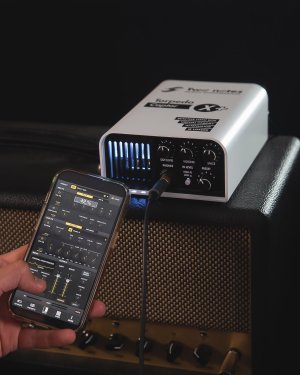
 More Info Here: https://www.two-notes.com/en/torpedo-series/torpedo-captor-x-plus/ Watch the Launch Video: Watch the Feature Rundown with Guillaume Pille:
 Hi Guys,
If you’re already looking at the Captor X or reactive loads in general, it’s probably worth knowing that Captor X + has just landed.
It builds on the original Captor X (which a lot of people here are already using), but addresses quite a few of the things players have been asking for — especially around flexibility and stereo workflows.
A few of the bigger updates:
What’s nice is it still keeps the core appeal of the original — simple to use, sounds solid, works equally well for silent practice, recording, or going straight to FOH — but just opens things up quite a bit more if you’re running a modern setup.
- True stereo DynIR processing — you can now run dual mics/IRs across a proper stereo field, so it’s not just “widened mono,” it actually gives you a much more realistic cab feel when going direct or tracking
- Virtual Load Shaper — this is new, and pretty interesting… it lets you tweak the post-load response, so you can tighten lows, add bite, or shift the feel a bit without touching your amp
- More flexible routing — stereo, dual mono, dry/wet etc., which makes it easier to fit into more complex setups or hybrid rigs
- USB-C + updated architecture — generally just a bit smoother and more future-proof in terms of connectivity and control
If you’re already considering a load box / attenuator / cab sim combo, it’s definitely one to have on your radar.

Hi Guys,
If you’re already looking at the Captor X or reactive loads in general, it’s probably worth knowing that Captor X + has just landed.
It builds on the original Captor X (which a lot of people here are already using), but addresses quite a few of the things players have been asking for — especially around flexibility and stereo workflows.
A few of the bigger updates:
What’s nice is it still keeps the core appeal of the original — simple to use, sounds solid, works equally well for silent practice, recording, or going straight to FOH — but just opens things up quite a bit more if you’re running a modern setup.
- True stereo DynIR processing — you can now run dual mics/IRs across a proper stereo field, so it’s not just “widened mono,” it actually gives you a much more realistic cab feel when going direct or tracking
- Virtual Load Shaper — this is new, and pretty interesting… it lets you tweak the post-load response, so you can tighten lows, add bite, or shift the feel a bit without touching your amp
- More flexible routing — stereo, dual mono, dry/wet etc., which makes it easier to fit into more complex setups or hybrid rigs
- USB-C + updated architecture — generally just a bit smoother and more future-proof in terms of connectivity and control
If you’re already considering a load box / attenuator / cab sim combo, it’s definitely one to have on your radar.

Ha! True that - even working in this industry, I still chuckle from time to time :).“Virtual Load Shaper” was definitely a choice.
Is the shaping of said load a mechanical process or is it an EQ stage?
There is actually a preset load response in the Virtual Load Shaper for Reload II! :)Interesting. Was the load updated to match the Reload II? That's really all I care about
Does that mean it's a software emulation of the Reload II on top of the analog load, then?There is actually a preset load response in the Virtual Load Shaper for Reload II! :)
Great question, yes, however it is not just a response super-imposed on-top of another - rather, it takes into account the existing hardware load to ensure the VLS preset you initiate (or a custom response you design) is accurately represented. Let me know if this helps to clarify things.Does that mean it's a software emulation of the Reload II on top of the analog load, then?

Thanks for getting back to me. Definitely a nice suggestion and I will certainly field that to our influencer network for sure. In the meantime, if you get a change to demo a unit, I cant recommend it enough! :)S’appenin @Ross Davies
Any chance of some audio comparison examples showing some amps with a real cab, and then using captor X’s impedance trickery to match the response?
If it’s easier, the real cab can just provide the load and an IR can be added afterwards. Ideally with lots of palm mutes to really hear the resonant frequency of the cabinet.
I’ve always been curious how well software can handle this, especially as the effects tend to vary amp to amp and cab to cab. My feeling has always been that the closer to electrical load is to the cabinet being modelled, the less that needs to be done to make up the difference.