Noise Gate Pedals: What's Your Poison?

Don't what to tell you man ¯\_(ツ)_/¯
People do perceive (feel) latency added by a digital device (or whatever) it's a well documented fact.
Yeah, the walls are cracking, the wood is crying, and a salad is yelling ‘eat meat!’ Magneto met your mom, so now you feel a 3 ms delay 🍿
 
I do have superpowers, that's obvious.

What's not all that obivious here is what are you arguing about. ¯\_(ツ)_/¯

Do you really believe that adding an always on digital pedal in front of an analogue rig makes no difference?
If that's the case I suggest you to play some more guitar.

And you seem offended that not everyone prefers a digital noise gate.
If that's the case I suggest you to get some help.
 
Last edited:
I grabbed a boss ns2 a while ago and it was terrible for a tight gate (yes I had it in 4cm). Picked up a sentry and it works well.

I notice a decent volume boost when it’s engaged so if I turn it off and on my OCD doesn’t like it for demos because of that happening.

If it’s always on I can set things fine and it works like a champ. Id use it for gigging or constant jamming no problem.

For doing demos I actually just use reaper these days 🤦‍♂️. Theres a clean DI hitting one input and then the loadbox out hitting another input, just take the key from the DI and feed it to the auxiliary tracks of the loadbox signal and it works like a 4cm gate, handy if you have the equipment
 
I do have superpowers, that's obvious.
Yeah — it’s called ignorance.
The I-MAN.

5f3dea70-6128-416f-918b-a943ddbbc48a.png


Do you really believe that adding an always on digital pedal in front of an analogue rig makes no difference?
If that's the case I suggest you to play some more guitar.
It makes a difference. A tiny one, but still. Btw:

Do you really believe that *** makes no difference? If that's the case I suggest you to *** some more ***.
universal shit :popcorn

And you seem offended that not everyone prefers a digital noise gate.
I can’t be offended — I’m an adult, white, heterosexual male.

If that's the case I suggest you to get some help.
Your turn!
 
One thing I’ve learned in guitar forums over the years: questioning what anyone says they hear/experience is a pointless exercise in futility.

Sensory perception is not uniform across the human race. Unless you have the ability to experience it yourself through the senses/mind of another person it’s pointless to speculate subjectively about your opinion on their claims, because they are the only one in a position to empirically validate their own statements.

Since it’s not exactly a subject where the fate of humanity hangs in the balance, for me it’s always best to just take them at their word and move on.

Even if the person is lying, so what? It doesn’t impact me one way or another so why waste my time worrying about it ¯\_(ツ)_/¯
 
One thing I’ve learned in guitar forums over the years: questioning what anyone says they hear/experience is a pointless exercise in futility.

Sensory perception is not uniform across the human race. Unless you have the ability to experience it yourself through the senses/mind of another person it’s pointless to speculate subjectively about your opinion on their claims, because they are the only one in a position to empirically validate their own statements.

Since it’s not exactly a subject where the fate of humanity hangs in the balance, for me it’s always best to just take them at their word and move on.

Even if the person is lying, so what? It doesn’t impact me one way or another so why waste my time worrying about it ¯\_(ツ)_/¯
I agree with you about sensory perception, and that’s why I prefer to rely on well-known biological facts rather than personal opinions.

Your point about ignoring these folks is valid for an ephemeral discussion that will disappear tomorrow. Unfortunately, the fakes will remain, and new users may find them and mistake them for the truth, which lowers the quality of the resource or even discredits it. Adding a bit of well-known, verified information is always helpful. Later, people can decide whether they trust “I hear a 3 ms digital delay” or “the auditory system has about a 150 ms lag” when making future decisions.
 
@nikitasius

Biological latency is perceived as instantaneous and you, despite being male, white and heterosexual (you really wrote that shit! 😂) don't understand what you're talking about.

The delay inherent in your nervous system is the baseline your brain is calibrated to. You have never known anything faster.

The statement that you can't perceive small amounts of latency because biological latency is bigger is false.

You're parroting false informations because...Because? whatever reasons you have it doesn't matter.

Grow up kid.
 
I can provide the full 5000 words document created by Gemini deep research:


7. Conclusion
The human perception of sound as "immediate" is a sophisticated neurocomputational achievement, not a passive reflection of reality. It is the result of a system that manages its own mandatory latencies through a combination of hardware architecture and software-like predictive algorithms.
The biological latency of 10-100 ms is rendered invisible because:
It is the Reference Frame: Being a throughput delay, there is no "faster" signal to compare it against.
Temporal Integration: The 30 ms "Horizon of Simultaneity" buffers asynchronous frequency components into unified events.
Predictive Coding: Top-down models pre-activate sensory cortices, effectively anticipating the present.
Retroactive Antedating: Conscious awareness is backdated to the moment of stimulus arrival.
This latency is fundamentally different from signal processing latency because neural processing is serial (avoiding phase cancellation/comb filtering) and the brain actively recalibrates to constant external delays (distance compensation). The "now" we inhabit is a specious present, a carefully constructed narrative that allows us to interact with a dynamic world in real-time, despite the sluggishness of the biological machinery that percei
ves it.
 
Last edited:
And again I can provide the full >5000 deep research

11. Conclusion
Is it possible for an electric guitar player to perceive DSP added latencies between 1 and 3 milliseconds? The answer is a nuanced yes, but the mechanism of perception is rarely a direct sensation of "time delay."
Auditory Perception (Spectral): It is highly possible to perceive 1–3 ms latency as a change in tone quality (comb filtering) when the unamplified sound of the electric guitar is audible. This manifests as a "hollow," "phasey," or "plastic" timbre due to cancellation notches at 250–500 Hz. This is the most common way players detect latency in home/practice environments.
Tactile Perception (Sensorimotor): It is plausible but subtle for expert players to perceive a disconnect between the bone-conducted vibration of the attack (t=0) and the auditory sustain (t=1\text{--}3 ms). This manifests not as a delay, but as a change in the "feel" or "stiffness" of the amp's response, often described as a lack of immediacy.
Rhythmic Perception (Temporal): It is virtually impossible to perceive 1–3 ms as a rhythmic error or a distinct echo. The human temporal integration window and JND for asynchrony are an order of magnitude larger (20–30 ms).
Therefore, the "1 foot = 1 ms" heuristic, while physically accurate, is psychoacoustically incomplete because it ignores the interference effects of the dual-path signal and the bone-conducted tactile reference. Players sensitive to 1–3 ms are not hallucinating; they are reacting to real physical phenomena (phase cancellation and tactile asynchrony) that occur even when the time interval itself is vanishingly s
mall.
 
you really wrote that shit! 😂
Well, thats a statement that i don’t belong to your offended bluehair camp.
The delay inherent in your nervous system is the baseline your brain is calibrated to. You have never known anything faster.
1-5ms for pre-processing and brains calibrate itself differently to smooth delays.

The statement that you can't perceive small amounts of latency because biological latency is bigger is false.
Small is relative, but you trying to pump your little theory again and again thinking it will help 🍿

You're parroting false informations because...Because? whatever reasons you have it doesn't matter.

I can ask a LLM generate any text, but i will share this:

No, you cannot consciously feel the difference between a 0ms and a 3ms audio delay after tapping a button. A 3ms delay is far below your perceptual threshold.

Also:
  • Research indicates the JND is typically in the range of 20 to 50 milliseconds for most people in standard conditions.
  • Highly trained individuals (e.g., professional musicians or audio engineers in focused tests) might lower this threshold to around 10-20 ms under ideal conditions.
  • 3 milliseconds is an order of magnitude smaller than even the best human sensitivity. It is physiologically imperceptible for conscious discrimination.
Just-Noticeable Difference (JND)

So, follow the only smart thing you said:
Grow up kid.
 
Also, it looks like you don’t understand how digital delay works, so you keep calling for tone changes in gemini mess. A digital delay is stable at any frequency. In my tests - with the manual error from adjusting the oscilloscope cursors - I measured between 2.50 and 2.60 ms for frequencies ranging from 82 Hz (guitar low E) up to 10 kHz.

That’s just processing time. Do you actually know how a CPU works?
 
Re: Noise Gate
Been using this for a whole lot of years and it has always been working fine:


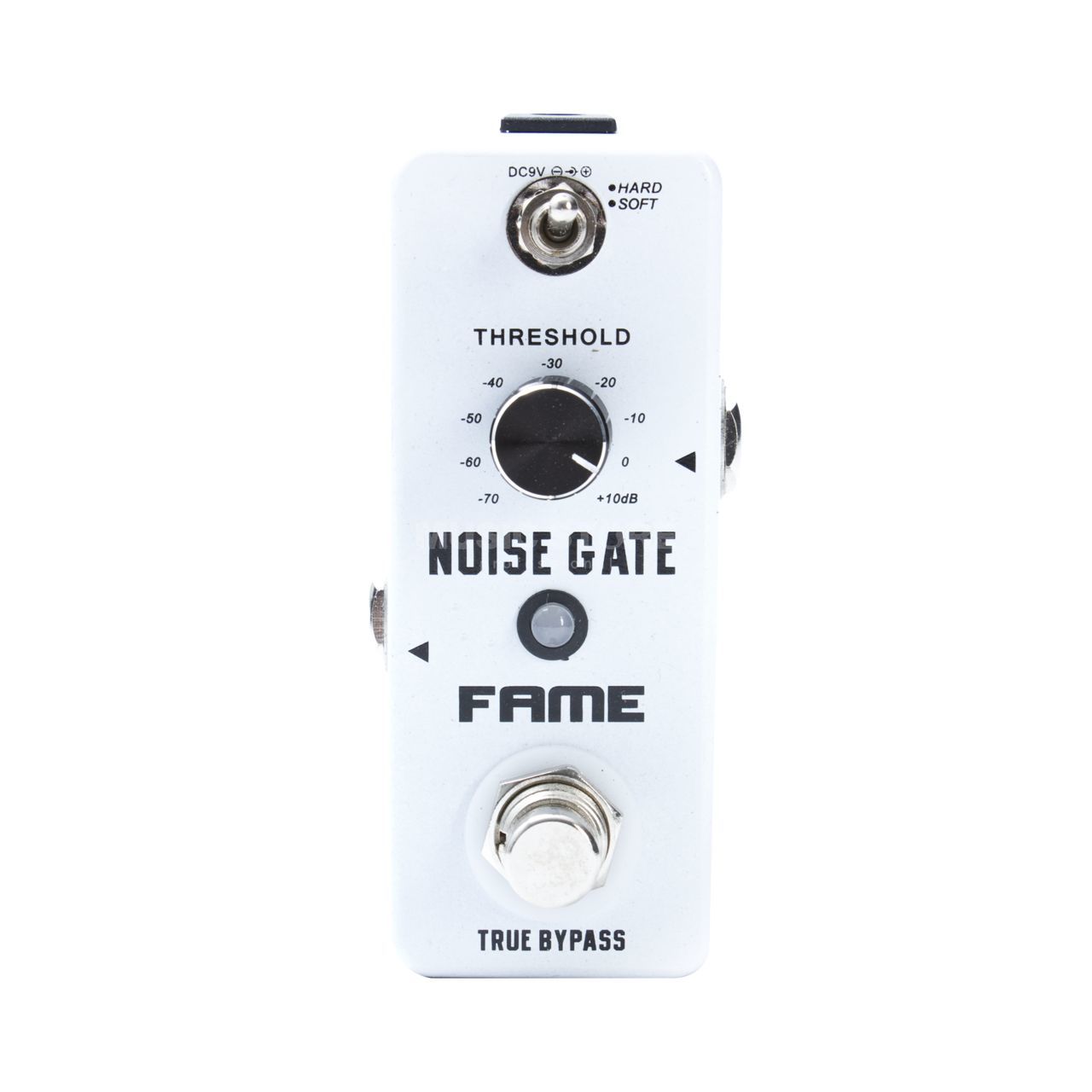
Absolutely no fuss, super simple but working. Very obviously, it's a gate that also comes from other companies (possibly Joyo, Donner, Harley Benton and whomever), they're all the same, just rebranded.
You can surely get much better gates (with trigger inputs, release controls and what not), but in case you don't have much noise issues, I always found this simple thing to just do the job.

---

Re: Latency
I'm sort of quite a bit into that topic since decades already, and there's too many implications (some pretty astounding ones included) to cover them all right here. There's also no simple, universal truth about how which kinds of latency perceptions affect which persons, it's a pretty wild mixture of things.
But there's still a very simple and universal (yes!) truth about latency in general (not about the perception): Try to avoid it as much as you can. If you have the choice between a tool introducing latency and another tool not doing so, as long as they're playing on a similar level (or even if they don't but just "get the job done"), choose the one not introducing latency. As easy as that.

 
Re: Noise Gate
Been using this for a whole lot of years and it has always been working fine:


Absolutely no fuss, super simple but working. Very obviously, it's a gate that also comes from other companies (possibly Joyo, Donner, Harley Benton and whomever), they're all the same, just rebranded.
You can surely get much better gates (with trigger inputs, release controls and what not), but in case you don't have much noise issues, I always found this simple thing to just do the job.

---

Re: Latency
I'm sort of quite a bit into that topic since decades already, and there's too many implications (some pretty astounding ones included) to cover them all right here. There's also no simple, universal truth about how which kinds of latency perceptions affect which persons, it's a pretty wild mixture of things.
But there's still a very simple and universal (yes!) truth about latency in general (not about the perception): Try to avoid it as much as you can. If you have the choice between a tool introducing latency and another tool not doing so, as long as they're playing on a similar level (or even if they don't but just "get the job done"), choose the one not introducing latency. As easy as that.

I'm always been in the "just do the job" camp with noisegates beacuse I never needed extreme ones and I don't use it as an always on tool.
I use my volume pot quite a bit for controlling saturation or getting cleanish sounds and that doesn't get along with noise gates very well.

With analog rigs I turn it on only in songs or sections I know it's needed otherwise I keep it off.
With digital or hybrid rigs (my helix floor) I always have the noise gate only on the dirty sounds paths and assigned to a FS.

I'd say that a simple mute switch placed in the amp loop would cover 90% of my gate needs and that's somenthing I'll add sooner or later.

I could move the tuner in the loop but that makes thing more complicated on stage, between songs. I prefer to prepare the board, then check the tuning while waiting for the count in.
 
Last edited:
Back
Top