Impedance plot of speaker cabinets for design of reactive load.


The Marshall 4x12 loaded with GB+V30 is a 16ohm cab.

I took the liberty of spicing your cab... Maybe this is your excuse to build a 16 ohm load ;-) I'll send you the files (or just the values if you're a masochist) if you're interested. The upper rise portion is exaggerated to compensate for whatever is going on in the highs in my box and will probably need to be changed, and I'm guessing at the actual magnitude and Q of the resonant peak.
Skjermbilde 2024-09-11 kl. 09.04.21.png
 
Last edited:
Hey slight bump, but anyone got one of these plots for any of the Two Notes loadboxes ??
 
Ok, I'm calling it... Now to figure out what causes the SPL to deviate from the impedance curve in the highs.
Update: It was/is the box. A tonewood version of the load does not exhibit any of the dampening effect at higher frequencies. Also, rearranging the high frequency inductors to a greater distance from the box walls reduced the effect.

Also: Omitting the parallel capacitors from L1 and L2 networks does not negatively affect the response (although I did need to increase the value of the second inductor by .1mH to compensate) and may (small enough to possibly be measurement error) actually improve the HF response a smidge in box.

This surprised me so much that I forgot saving the measurement files. I'll include a screenshot off LTSpice in hopes of avoiding your disapproval.

Apologies for the excessive editing. I can't brain today.

Skjermbilde 2024-11-16 kl. 14.01.50.png
 
Last edited:
@Humbug Are you still working on this kind of stuff?? Any new developments??
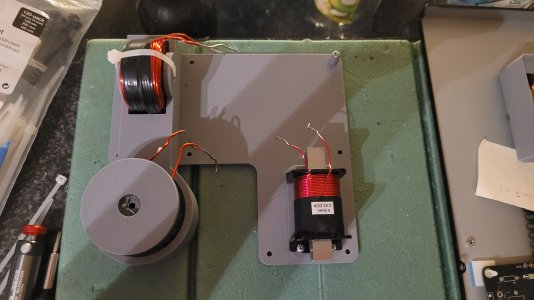
Thanks for asking! I am still working on it but, as I had to grow up and get a proper job about a year ago, things are moving very slowly. I did 3D print a mounting contraption that allows for more precise placement of the components, and I hope to have an improved circuit board finished in a few months.

20260104_013217.jpg
 
Great thread! Ive been watching the internet for years on the topics of load boxes and attenuators, but only just found this.

My stuff is on the Marshall Forum:

(huge thread, but post#1 has the key info)

It focusses mainly on attenuators rather than load boxes, but it was heavily inspired by the Aiken design and particularly @James Freeman 's TGP thread. My lightbulb-moment was to find how extend that thinking to accurately scale down the signal to the speaker, while keeping tone intact.

I also needed cab impedance info, and Mike Lind on TGP has some great files, including a G12M 1960 cab.


For the attenuators, we found that the bass resonance circuit wasnt too important, since theres a real cab involved which can do it itself. But we have an option for one anyway. Its more important when its a load box

On this thread, what type of caps are you using? The big film caps are best, but big and expensive? Some designs use bipolar electrolytic, but I worry about ripple current ratings.

 
On this thread, what type of caps are you using? The big film caps are best, but big and expensive? Some designs use bipolar electrolytic, but I worry about ripple current ratings.
Wonderful to see you here! Your attenuator circuit is a great design.

I have decided to stick with polarised electrolytics for the next revision - 3 banks of 2 back to back should handle enough current for guitar amp use even if the individual specs are not the greatest, and allows for more flexibility on one PCB. I also suspect that multiple small(er) elements may be less inclined to couple inductively to the other elements in the box. This may also have some correlation with the back to back configuration. I hope to conduct more experiments to get rid of the "seems" and "mays" at some point.

The inductor coupling issues could probably be significantly reduced by using toroidal inductors but I have not been able to find suitable ones :-(
 
Back
Top