
Captor X + — New Release from Two notes!

Ross Davies

Roadie
Vendor
Messages
223
Hi all — Ross from Two notes here!

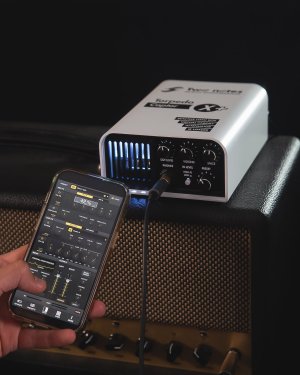
We’ve just released Captor X +, which is the successor to the original Captor X, and I thought it might be useful to share a bit of context here given how many discussions there have been around reactive loads, attenuation, and direct rigs across The Gear Forum (@Alex Kenivel :) )

Rather than a full product pitch, I’ll keep it to what’s actually changed and why:
  • True Stereo DynIR™ processing — this was a big one for us. The goal was to move beyond mono cab simulation and give proper dual-mic / IR control across a real stereo field, especially for players running stereo rigs or recording direct
  • Virtual Load Shaper — a new feature that lets you adjust the post-load response of the amp. In practice, it means you can tweak feel and tonal balance of your amp/load interaction for Captor X +'s direct outputs
  • Expanded routing options — in a nutshell: enhanced stereo, dual mono, dry/wet modes. This came directly from user feedback around more complex live and studio setups
  • Updated architecture + USB-C — mainly about improving integration and making the platform more future-proof
What’s nice is it still keeps the core appeal of the original — simple to use, sounds solid, works equally well for silent practice, recording, or going straight to FOH — but just opens things up quite a bit more if you’re running a modern setup.

If you’re already considering a load box / attenuator / cab sim combo, it’s definitely one to have on your radar.

Happy to answer any questions, get into the details, or hear feedback — especially from those of you who’ve spent time with the original!

➡️ More Info Here: https://www.two-notes.com/en/torpedo-series/torpedo-captor-x-plus/

➡️ Watch the Launch Video:

➡️ Watch the Feature Rundown with Guillaume Pille:
 

Attachments
  • Captor X + LS Image - 12.jpg
    Captor X + LS Image - 12.jpg
    228.1 KB · Views: 2
Last edited:
Nice - just watching the vid now.

Could you share more details on the Virtual Load Shaper? Is it Convolution, EQ-based, software modeled?
 
Nice - just watching the vid now.

Could you share more details on the Virtual Load Shaper? Is it Convolution, EQ-based, software modeled?
Thanks for getting back to me - sadly when it comes to the VLS, that firmly falls under our proprietary technology but I have received this from our development team...

Our new Virtual Load Shaper in the Captor X+ was developed using a proprietary algorithm, taking into account both the dynamic response of amplifiers when connected to different load conditions and the specific hardware characteristics of the Captor X +'s internal reactive load. Accurately reproducing these behaviors required extensive modeling and validation to ensure that the amplifier responds and feels authentic under real-world conditions.

Let me know if this clears things up a little!
 
Congrats on the new release! It’s always great to see new awesome products come to market from great companies.

The biggest problem I’ve had with the older Captors (I’ve owned the Captor and Captor X) was that I always had to do quite a bit of EQ in post to get it to sound right. The consensus seems to be that the speaker impedance curve is a bit suspect in Captor devices, and some of your competitors have more realistic impedance curves. Using an Axe FX, you can see these graphically as most of the Fractal impedance curves for speaker types are shaped more like what you’d expect, but the Two Notes variant is very rounded.

So I guess what I’m saying is I’ve always loved the idea of the captor X but struggled with the impedance curve. How is this one different?
 
[...] post-load response of the amp. [...]
Not sure what you mean. It sounds as if I were having a dump and then thinking there were multiple flushing settings that my bowel reacts differently to.

I don't think an amp can react differently to something that comes after the load.

Confused Hanna Barbera GIF by Warner Archive
 
Congrats on the new release! It’s always great to see new awesome products come to market from great companies.

The biggest problem I’ve had with the older Captors (I’ve owned the Captor and Captor X) was that I always had to do quite a bit of EQ in post to get it to sound right. The consensus seems to be that the speaker impedance curve is a bit suspect in Captor devices, and some of your competitors have more realistic impedance curves. Using an Axe FX, you can see these graphically as most of the Fractal impedance curves for speaker types are shaped more like what you’d expect, but the Two Notes variant is very rounded.

So I guess what I’m saying is I’ve always loved the idea of the captor X but struggled with the impedance curve. How is this one different?
Thanks for getting in touch and a great question. The VLS should help rectify the previous issues you were having as it lets you shape a Virtual Impedance curve before the cabinet simulation and post FX. In our feature run down vid, we actually have some audio demos (please use headphones) and you can hear it in action — I would also say there is a lot on the feel front that you obviously cant experience listening to a video, however I personally have really enjoyed playing with this!
 
Not sure what you mean. It sounds as if I were having a dump and then thinking there were multiple flushing settings that my bowel reacts differently to.

I don't think an amp can react differently to something that comes after the load.

Confused Hanna Barbera GIF by Warner Archive
Ha! Good analogy.

If you were looking at your amp's response on it's own, it would be subject to the Captor X's physical internal load. With that said, with the VLS we have worked hard to alter feel, response and a tonal impact of the Direct feed from the Captor X +. As such, it is implemented post the internal load but also works to counteract the impact Captor X load. We're super pleased with the results and encourage anyone interested to give it a demo - interestingly this was a common feedback point on the OG Captor X
 
What load will the amp actually see?

How will this affect non negative feedback amps vs those with negative feedback?
 
What load will the amp actually see?

How will this affect non negative feedback amps vs those with negative feedback?

Thanks for weighing in. To clarify, the Amp sees the hardware load of the Captor X +.

The VLS is a post hardware load processing meaning the amps (both non negative feedback amps and those with negative feedback) will be affected equally by the VLS, independently of their architecture.
 
Back
Top